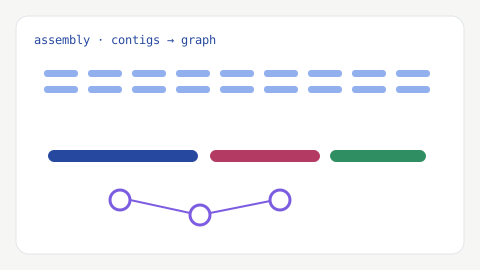
Genome assembly is the process of reconstructing an organism’s genome from the many short or long fragments a sequencer produces — piecing a shredded book back together from overlapping scraps, without necessarily having the original to copy from. The two dominant sequencing technologies, short-read and long-read, lead to fundamentally different assembly strategies and trade-offs. This guide explains how each works, why they differ, and how to judge whether an assembly is any good.
Assembly is also a gateway step: annotation, comparative genomics, and variant analysis all inherit whatever the assembly gets right or wrong. A fragmented or error-ridden assembly quietly caps the quality of everything built on top of it, which is why the choice of technology and the care taken here repay themselves many times over across a project.
Key takeaways
- Short reads are highly accurate per base but fragment the assembly wherever a repeat is longer than the read.
- Long reads span repeats and give far more contiguous assemblies, historically at some cost to per-base accuracy.
- Hybrid and polishing strategies combine the strengths of both to reach accurate, contiguous genomes.
- Assembly quality has three axes — contiguity, completeness, and accuracy — and all three must be checked.
What genome assembly is
When no closely related reference genome is available — or when you specifically want the organism’s own sequence — reads are assembled de novo, by finding where they overlap and stitching them into longer stretches called contigs. Contigs may then be ordered and oriented into scaffolds, and ideally into complete chromosomes. Assembly differs from the alignment-based workflows used when a good reference exists; here, the genome is built from the reads themselves, which is why the sequencing technology’s characteristics matter so much.
The core challenge: repeats
The single hardest problem in assembly is repetitive DNA — sequences that occur in near-identical copies at multiple genomic locations. When a repeat is longer than a read, the assembler cannot tell which copy a given read came from, so it cannot confidently connect the unique sequences flanking the repeat. The result is a break in the assembly. This is why read length is so decisive: nearly every difference between short-read and long-read assembly traces back to how each handles repeats.
Short-read assembly
Short reads (typically Illumina, ~100–300 bp) are assembled with the de Bruijn graph approach, used by assemblers such as SPAdes. Rather than compare every read to every other, the method breaks reads into fixed-length k-mers and builds a graph in which overlapping k-mers are connected; a genome then corresponds to a path through that graph. This is computationally efficient and, because short reads have very low per-base error, the resulting sequence is highly accurate. The catch is contiguity: repeats longer than the read length create tangled, ambiguous regions in the graph that cannot be resolved, so short-read assemblies are typically accurate but fragmented into many contigs.
Long-read assembly
Long reads (Oxford Nanopore and PacBio, from thousands to hundreds of thousands of bases) are usually assembled with an overlap-layout-consensus (OLC) or related string-graph / repeat-graph strategy, used by assemblers such as Flye, Canu, and hifiasm. Because a single read can span an entire repeat, long reads resolve the ambiguities that fragment short-read assemblies, producing far more contiguous results — often complete or near-complete bacterial chromosomes. Historically the trade-off was higher per-base error, but this has narrowed dramatically: PacBio HiFi reads are highly accurate by design, and recent Nanopore chemistry (R10.4) reaches very high consensus accuracy, so long-read-only assemblies are increasingly used without short-read correction.
Hybrid assembly
When both data types are available, hybrid assembly combines them to get the best of each: long reads provide the scaffolding and repeat resolution, while accurate short reads correct residual base errors. Tools such as Unicycler (for bacteria) and MaSuRCA (for larger genomes) implement this. Hybrid approaches were the standard route to a finished, accurate genome for years and remain a reliable, cost-effective choice — particularly where long-read accuracy alone is marginal for the application.
Polishing
Polishing corrects residual errors in a draft assembly by mapping reads back to it and updating the consensus. Long-read polishers such as Racon and Medaka refine the sequence using the long reads themselves, while short-read polishers such as Pilon and NextPolish fix remaining base-level errors (especially the homopolymer and indel errors that long reads are prone to) using accurate Illumina data. Polishing measurably improves genome completeness and base accuracy, and skipping it is a common reason downstream gene predictions come out truncated.
Assessing assembly quality
A good assembly is judged on three independent axes, and a single number never tells the whole story. Contiguity is summarised by N50 (the length such that half the assembly sits in contigs at least that long) and the total number of contigs, reported by tools like QUAST. Completeness is estimated with BUSCO (or CheckM for bacteria), which checks for expected single-copy marker genes. Accuracy is the per-base correctness of the consensus. An assembly can be highly contiguous yet error-ridden, or accurate yet fragmented — so all three are reported together, matching the assembly to what the downstream analysis actually needs.
Scaffolding to chromosomes
Even a good contig-level assembly is not yet chromosome-scale. Scaffolding orders and orients contigs using long-range information: Hi-C (chromosome conformation capture) data, optical maps, or long reads themselves provide the linkage needed to arrange contigs into full chromosomes and to place gaps. For many bacterial genomes, long reads alone already yield closed chromosomes; for large, repeat-rich eukaryotic genomes, scaffolding is a substantial, distinct stage of the project.
Choosing an approach
The right strategy follows from the question and the budget. For draft assemblies used for gene screening or typing, short reads are inexpensive and sufficient. For complete, closed genomes — resolving plasmids, structural features, or repeat-rich regions — long-read or hybrid sequencing is the reliable route. Genome size, repeat content, and ploidy all shift the balance, and heterozygous or highly repetitive genomes need particular care. Deciding this before sequencing, rather than discovering a fragmented assembly afterwards, is one of the highest-value choices in a project — and where our pipeline design input pays off.
Common pitfalls
The recurring assembly mistakes are avoidable. Judging an assembly by N50 alone rewards contiguity while hiding errors and missing content. Skipping polishing leaves indels that truncate predicted genes. Undetected contamination in the reads produces chimeric contigs. Expecting a closed genome from short reads misjudges what the data can deliver. And ignoring heterozygosity in diploid genomes creates artefactual duplicated contigs. A documented, versioned assembly pipeline with QC at each stage — the standard we build to — prevents most of these.
Assembling metagenomes
Assembling a single organism is hard enough; assembling a metagenome — a mixture of many species sequenced together from an environmental or clinical sample — adds a layer of difficulty. The reads come from organisms present at wildly different abundances, closely related strains blur together, and there is no single genome to reconstruct. Specialised assemblers such as metaSPAdes, MEGAHIT, and metaFlye are built for this, handling the uneven coverage that would confuse a standard assembler.
Metagenome assembly typically does not stop at contigs. A subsequent binning step groups contigs that appear to come from the same organism — using coverage patterns and sequence composition, with tools like MetaBAT, MaxBin, or CONCOCT — to recover metagenome-assembled genomes (MAGs). Each MAG is then quality-assessed for completeness and contamination (with CheckM), because a bin that mixes two organisms is worse than useless. Long reads help here too, spanning repeats shared between community members that fragment short-read metagenome assemblies. It is a demanding workflow, but it is what allows genomes to be recovered from unculturable organisms straight from a sample.
Conclusion
Short-read and long-read assembly are not competitors so much as tools for different jobs: short reads give accurate, economical drafts; long reads give contiguous, often-complete genomes; and hybrid and polishing strategies combine their strengths. Getting a usable genome depends on matching the approach to the biological question and then checking contiguity, completeness, and accuracy honestly. If you’d like your data assembled and validated end to end, our team handles the full workflow — tell us about your genome and we’ll scope it.