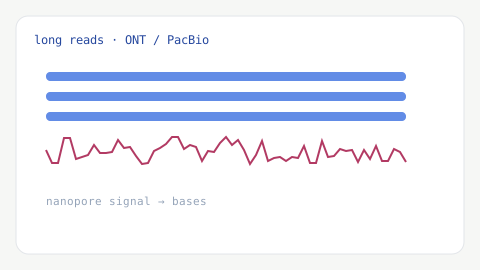
Long-read sequencing reads DNA (or RNA) in fragments thousands to hundreds of thousands of bases long — orders of magnitude longer than short reads. That length unlocks analyses short reads struggle with: complete genome assembly, large structural variants, haplotype phasing, native base modifications, and full-length transcripts. But long reads have a distinct signal, error profile, and toolchain, so the analysis differs meaningfully from the short-read workflows most people start with. This guide covers the two dominant platforms and the analysis path from raw signal to biology.
Long-read sequencing has matured rapidly from a niche, error-prone technology into a mainstream tool. Early platforms traded accuracy for length, which limited their use to specialised applications; today, PacBio HiFi and the latest Nanopore chemistry deliver reads that are both long and accurate enough for reference-quality work. Just as importantly, the analysis ecosystem has caught up: robust basecallers, aligners, assemblers, and variant callers now exist specifically for long-read data. The result is that long reads increasingly complement — rather than simply supplement — short reads, and for some questions have become the primary technology. Understanding the workflow is now part of the standard bioinformatics toolkit, not a specialist afterthought.
Key takeaways
- Oxford Nanopore and PacBio are the two main long-read platforms, with different chemistries and strengths.
- Basecalling (signal to sequence) is a distinct, consequential first step — the model used affects accuracy.
- minimap2 is the de facto aligner; assembly, structural variants, and methylation are core applications.
- Long reads directly detect base modifications and resolve repeats that short reads cannot.
Two long-read platforms
Oxford Nanopore (ONT) measures the electrical signal as a DNA strand passes through a protein nanopore. It offers very long (including ultra-long) reads, portable devices, real-time sequencing, and direct detection of base modifications from the native strand. Its latest chemistry (R10.4) reaches high consensus accuracy. PacBio uses single-molecule real-time (SMRT) sequencing; its HiFi reads, produced by reading a circular template multiple times to form a consensus, are long and highly accurate, and are generated on instruments such as the Revio system. In short: ONT excels at read length, portability, and native modification detection; PacBio HiFi excels at combining length with per-read accuracy.
Step 1 — Basecalling
Long-read platforms record a raw signal that must be translated into DNA bases — a step called basecalling that short-read users never see. For ONT, the raw signal (stored in pod5 files) is basecalled with Dorado (the current tool; Guppy previously), and the choice of model matters: “super-accurate” (SUP) models are slower but markedly more accurate. ONT can also produce higher-accuracy duplex reads by basecalling both strands, though at lower yield. For PacBio, the equivalent step is circular consensus (CCS) processing that generates the accurate HiFi reads. Because everything downstream inherits basecalling accuracy, this step is not a formality — it is a real determinant of assembly and variant quality.
Step 2 — Read QC
Long-read QC focuses on different metrics than short-read QC. Read-length distribution and read N50 tell you whether the library delivered the length you paid for; per-read quality (and the fraction of high-quality reads) indicates how much correction downstream steps will need; and total yield determines achievable coverage. Tools such as NanoPlot and NanoStat summarise these. As a rough guide, Nanopore read-length N50 commonly falls in the tens of kilobases — with ultra-long protocols reaching well beyond 100 kb — while PacBio HiFi reads typically centre around 15–20 kb, so the expected distribution itself depends on the platform and library preparation. A run with a disappointing read-length N50 — often a sign of DNA fragmentation during extraction — undermines the very advantage long reads are meant to provide, so it is worth catching early.
Step 3 — Alignment
When a reference is available, long reads are aligned with minimap2, the de facto standard aligner for both ONT and PacBio data (with presets tuned to each). minimap2 handles the higher error rates and long gaps characteristic of long reads, which short-read aligners like BWA are not designed for. Alignment underpins reference-based variant calling, structural-variant detection, and methylation analysis.
Step 4 — Applications
Long reads shine across several analyses. De novo assembly with Flye, Canu, or hifiasm produces contiguous, often complete genomes (covered in our assembly guide). Structural variants — large insertions, deletions, inversions, and translocations that short reads miss — are called with tools such as Sniffles and cuteSV, because a single long read can span an entire event. Small-variant calling uses long-read-aware callers like Clair3 or PEPPER-Margin-DeepVariant. Base modifications such as DNA methylation are detected directly from the native signal — no bisulfite conversion required — using tools like Modkit. And full-length transcripts can be sequenced end to end (PacBio Iso-Seq, ONT cDNA or direct RNA), resolving isoforms that short-read RNA-seq can only infer.
Strengths and limitations
The strengths follow directly from read length: repeats are spanned, structural variants are captured, haplotypes can be phased over long distances, and modifications and full-length isoforms are read natively. The limitations are equally concrete. Per-read error rates, while much improved, are generally higher than Illumina’s — ONT in particular has historically struggled with homopolymers, though R10.4 chemistry has largely addressed this. Cost per base and throughput considerations differ from short reads, and getting genuinely long reads depends on high-molecular-weight DNA extraction, which is a wet-lab constraint upstream of any analysis. Matching the platform to the biological question is the key decision.
Nanopore vs PacBio
Neither platform is universally better. Choose ONT for the longest reads (including ultra-long for the hardest repeats), portability and real-time analysis, direct RNA sequencing, and flexible, lower-barrier setups. Choose PacBio HiFi when you need long reads with the highest per-read accuracy in a single pass — often preferred for high-confidence variant calling and reference-quality assemblies. Many large projects use both, or combine long reads with accurate short reads. The right answer depends on whether your priority is maximum length, maximum per-read accuracy, native RNA, or budget — which is exactly the kind of design question worth settling before sequencing.
Common pitfalls
The recurring long-read mistakes are specific to the technology. Using a fast, low-accuracy basecalling model when accuracy matters degrades everything downstream. Applying short-read tools (aligners, variant callers) to long-read data gives poor results because they assume a different error model. Ignoring read-length QC masks a fragmented library that negates the platform’s advantage. And skipping polishing or short-read correction where the application demands high base accuracy leaves errors in the result. A pipeline built specifically for long reads — the kind we design per project — avoids these.
Real-time and adaptive sequencing
One capability unique to nanopore sequencing is that data stream off the device in real time, and can be basecalled and analysed while the run is still going. This enables fast turnaround for time-sensitive applications — a pathogen can begin to be identified within minutes to hours of loading the sample, rather than after a fixed run completes.
It also enables adaptive sampling (sometimes called “Read Until”): the software inspects the first fragment of each read as it enters a pore and decides whether to keep sequencing it or reject it and free the pore for another molecule. In practice this lets you enrich for target sequences — a panel of genes, a specific organism in a mixed sample, or non-host DNA — or deplete unwanted ones, all without extra wet-lab preparation. It is a genuinely different way of thinking about sequencing: rather than sequence everything and filter afterwards, you bias what gets sequenced in the first place. The trade-offs (some cost to overall yield, and dependence on a reference to decide targets) mean it suits particular questions rather than every project, but for targeted or host-depletion work it is a powerful, computationally-driven option.
Conclusion
Long-read sequencing opens up analyses that short reads cannot reach — complete assemblies, structural variants, phasing, native modifications, and full-length transcripts — but only through a workflow built for its distinct signal and error profile: careful basecalling, length-aware QC, minimap2 alignment, and long-read-specific downstream tools. If you have Nanopore or PacBio data and want it handled end to end, our team supports the full long-read workflow — tell us what you’re sequencing.