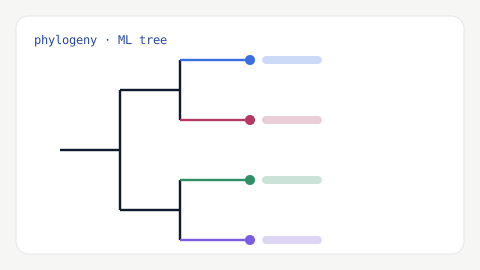
A phylogenetic tree is a hypothesis about how a set of sequences — genes, genomes, or organisms — are related through shared ancestry. Building one that holds up to scrutiny is a chain of careful steps, and mistakes early in that chain (a poor alignment, the wrong model) quietly propagate into a confident-looking but wrong tree. This guide walks the workflow from raw sequences to a publication-ready phylogeny, and stresses the interpretive discipline that separates a defensible tree from a misleading one.
Phylogenetics sits at the heart of biology, underpinning everything from taxonomy and evolutionary studies to epidemiology, drug development, and the real-time tracking of pathogens. Modern software has made building a tree deceptively easy — a few commands can turn sequences into a figure — but that ease hides how many decisions shape the outcome. The alignment method, trimming, substitution model, inference approach, and support measure each influence the result, and defaults chosen without thought can produce a tree that looks authoritative yet rests on shaky foundations. Treating each step as a deliberate choice, and reporting those choices, is what makes a phylogeny reproducible and trustworthy.
Key takeaways
- A tree is an inference, not a fact — its reliability depends on the alignment, model, and branch support.
- The multiple sequence alignment is the foundation; a bad alignment cannot yield a good tree.
- Substitution-model selection is a required step, not an optional one, for likelihood-based methods.
- Branch support values, and how they are interpreted, determine which parts of a tree you can trust.
What a phylogenetic tree represents
A tree has a topology (the branching pattern showing which taxa are more closely related) and branch lengths (typically the amount of evolutionary change along each branch). Reading one responsibly means remembering that it is an estimate from limited data under an assumed model of evolution — not a direct observation of history. That framing matters, because the same data can support different trees, and the confidence in each part of a tree varies. Everything downstream is about producing, and honestly qualifying, that estimate.
Step 1 — Multiple sequence alignment
Phylogenetics begins with homologous sequences aligned so that each column represents positions descended from a common ancestor. Aligners such as MAFFT and MUSCLE produce this multiple sequence alignment (MSA). The alignment is the single most important input: because tree inference treats each column as evidence, misaligned columns inject false signal. For protein-coding genes, aligning at the codon or amino-acid level often gives a more reliable result than raw nucleotide alignment. Time spent getting the alignment right is never wasted.
Step 2 — Alignment trimming
Real alignments contain ambiguously aligned or gap-rich regions that carry more noise than signal. Trimming tools such as trimAl or Gblocks remove these poorly aligned columns, leaving the confidently homologous positions that should drive the analysis. Trimming is a balance: too little leaves noise, too much discards real signal, so the settings deserve thought rather than defaults applied blindly — especially for divergent sequences.
Step 3 — Model selection
Likelihood-based methods need a substitution model describing how sequences change over time (relative rates of different substitutions, rate variation across sites, and so on). Choosing one is not guesswork: tools such as ModelFinder (built into IQ-TREE) test many models and rank them by statistical criteria like AIC or BIC, selecting the best fit for your data. Using an inappropriate model can bias both topology and branch lengths, which is why model selection is a required step in a rigorous ML or Bayesian analysis rather than an optional refinement.
Step 4 — Tree inference
With an alignment and a model, you infer the tree. Maximum likelihood (ML) is the workhorse: IQ-TREE and RAxML(-NG) search for the topology that best explains the data under the model, and FastTree offers a faster, approximate option for very large datasets. Bayesian methods such as MrBayes and BEAST instead estimate a distribution of trees and report posterior probabilities, and BEAST in particular is used for time-calibrated (dated) phylogenies. Simpler distance methods (like neighbour-joining) are fast but generally less accurate, and the practical choice of tool is also shaped by dataset size, since exhaustive tree searches become infeasible for very large alignments and favour the faster heuristics. For most modern work, ML with a well-chosen model is the standard, with Bayesian inference where its outputs (support as posterior probability, or divergence times) are needed.
Step 5 — Branch support
A topology without support values is only half a result. Bootstrapping resamples the alignment many times and rebuilds the tree to see how consistently each branch recurs; IQ-TREE’s ultrafast bootstrap (UFBoot) makes this efficient, and SH-aLRT provides a complementary branch test. Bayesian analyses report posterior probabilities instead. Crucially, the interpretation thresholds differ by method: standard (nonparametric) bootstrap values around 70–80% or higher are typically considered good support, whereas UFBoot values are interpreted more stringently — around 95% or above indicates a reliably supported clade — and Bayesian posteriors near 0.95–1.0 indicate strong support. Reporting which support measure was used, and reading it with the right threshold, is essential to honest interpretation.
Step 6 — Visualisation and annotation
The final tree is rendered for interpretation and publication. Tools such as iTOL, FigTree, and the ggtree R package produce clear, annotated figures — adding support values, colouring clades, and attaching metadata such as sampling location or host. A key decision at this stage is rooting: placing the tree’s base, usually with a known outgroup, so that ancestry reads in the right direction. An unrooted or mis-rooted tree can be badly misread, so rooting is a scientific choice, not a cosmetic one. Producing figures that are both accurate and publication-ready is part of our visualisation work.
Interpreting trees responsibly
Several well-known artefacts trip up interpretation. Low support on a branch means the data do not strongly favour that grouping — it should not be over-read. Long-branch attraction can artificially group rapidly evolving or distantly related taxa. And a gene tree is not necessarily the species tree: a single gene reflects its own history, which can differ from the organisms’ overall history, so multi-gene or genome-scale analyses give more robust conclusions. Presenting a tree honestly means highlighting what is well supported and being explicit about what is not.
Common pitfalls
The recurring phylogenetics mistakes are avoidable. Building a tree on a poor alignment guarantees an unreliable result. Skipping model selection biases likelihood-based inference. Reporting a topology without support values hides which parts are trustworthy. Misreading support thresholds (treating a UFBoot value like a standard bootstrap value) overstates confidence. And ignoring rooting leads to misinterpreted ancestry. A documented workflow with justified choices at each step — the standard we hold to — keeps a phylogeny defensible.
Time-calibrated and phylodynamic trees
Standard phylogenies show relationships and amounts of change, but not when divergences happened. Time-calibrated (dated) phylogenies add that dimension by applying a molecular clock — a model of how substitution rate relates to time — calibrated with dated information such as sample collection dates or fossil constraints. Bayesian frameworks like BEAST are the common tools, using either a strict clock (a single rate) or a relaxed clock (rates that vary across branches, which is usually more realistic).
This underpins phylodynamics: inferring the timing and dynamics of processes from sequence data, most visibly in pathogen genomics. Dating a phylogeny of viral or bacterial genomes can estimate when an outbreak began, how fast it is spreading, and how lineages move between locations — analyses made familiar by real-time tracking of SARS-CoV-2. The results are only as good as the assumptions, though: clock models, calibration quality, and adequate sampling all shape the estimates, so dated trees demand even more careful interpretation and honest uncertainty reporting than undated ones.
Conclusion
A trustworthy phylogeny is the product of disciplined steps: a careful alignment, sensible trimming, proper model selection, appropriate inference, honest branch support, and thoughtful rooting and visualisation. Get those right and the tree supports real conclusions; cut corners and it produces confident-looking errors. If you’d like a phylogenetic analysis done rigorously and rendered publication-ready, our team handles it end to end — from alignment to a figure your reviewers will accept.