
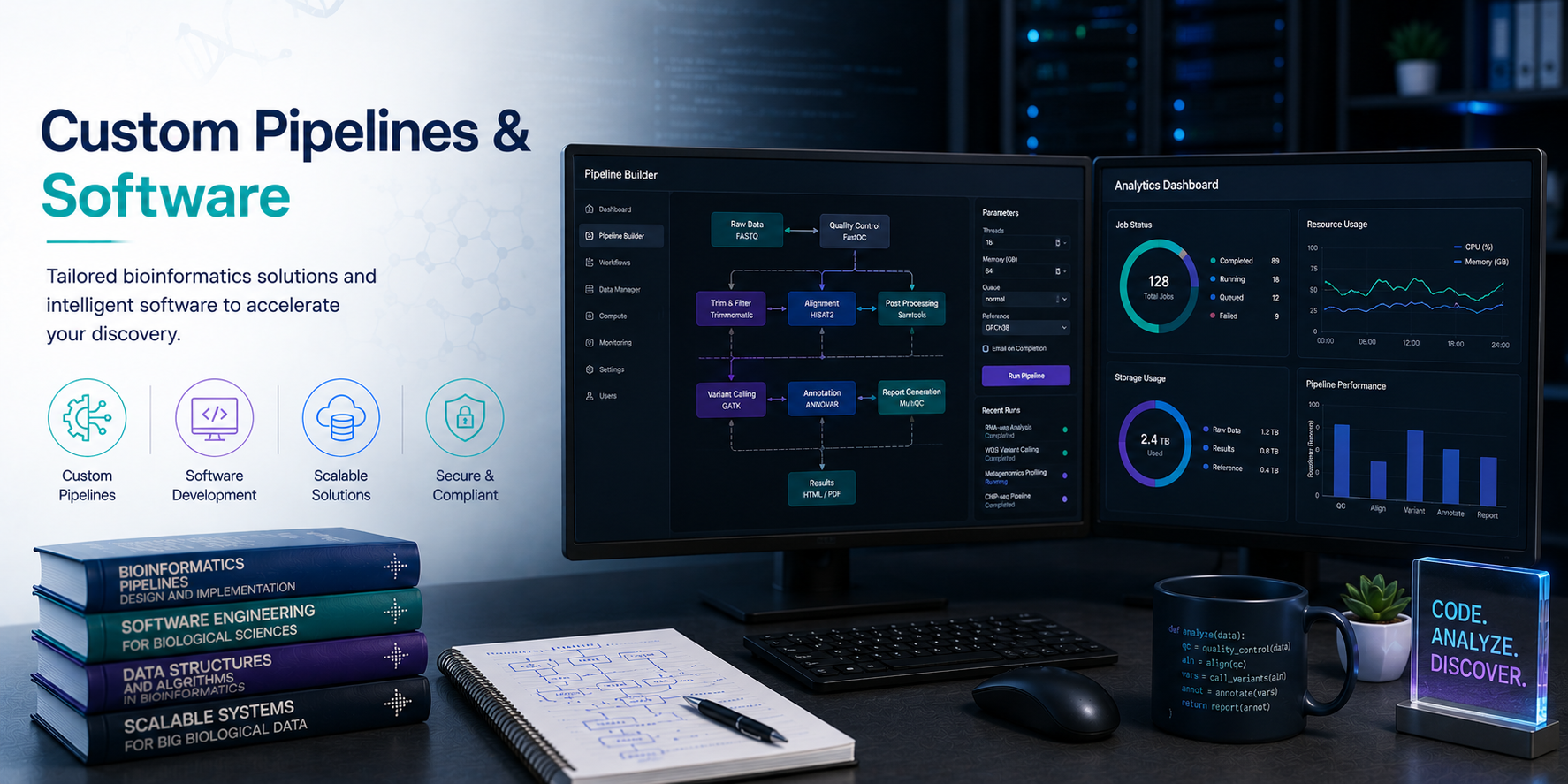
Every research project is unique — and sometimes the analytical tools and pipelines you need simply do not exist off the shelf. Whether you require a bespoke bioinformatics workflow tailored to a novel experimental design, a custom software application to process and visualise your data, a database to store and query your genomic results, or an automated pipeline to replace a slow and error-prone manual process, BioinformaticsNext provides expert custom software and pipeline development services to meet your exact needs. We turn your computational requirements into reliable, reproducible, and scalable solutions.
Custom Bioinformatics Pipelines & Software Development
From bespoke workflows to full-stack bioinformatics platforms — tools that work, scale, and last.
The bioinformatics landscape is rich with excellent tools — but no single combination of off-the-shelf software perfectly fits every research question, data format, organism, or experimental design. Many of the most impactful bioinformatics projects require custom development: a pipeline that integrates three different tools in a way no existing workflow manager supports, a visualisation dashboard that lets your team explore your data interactively, a database that connects your genomic results to your clinical metadata, or an algorithm tailored to the specific properties of your data.
At BioinformaticsNext, we build these solutions — combining software engineering expertise with deep bioinformatics and biological knowledge to deliver tools that work, scale, and last.
What We Build
Bespoke bioinformatics software, pipelines, databases, dashboards, and machine learning tools.
- Custom bioinformatics analysis pipelines for novel or non-standard data types
- Automated end-to-end workflows replacing manual, error-prone processes
- Interactive data visualisation dashboards for exploring omics results
- Genomic and biological databases with query interfaces and APIs
- Data submission tools for NCBI, ENA, and other public repositories
- Machine learning models for biological prediction and classification tasks
- Web applications for bioinformatics analysis and result reporting
- Scripts, utilities, and tools to extend or integrate existing bioinformatics software
Our Custom Development Services
End-to-end software and pipeline development — from requirements gathering through to implementation, testing, documentation, and long-term support.
All code is written to high standards of clarity, modularity, and reproducibility.
1. Custom Bioinformatics Pipeline Development Snakemake · Nextflow · nf-core · Cloud
A well-designed bioinformatics pipeline is reproducible, scalable, portable, and maintainable. We design and build custom pipelines using industry-standard workflow management systems — ensuring your analyses run reliably from raw data to final results, every time, on any computing environment.
- Snakemake pipeline development — Modular, rule-based workflow construction with Snakemake; conda environment integration; cluster and cloud execution support; comprehensive logging and error handling
- Nextflow / nf-core pipeline development — DSL2-based Nextflow pipeline development; nf-core template compliance for community sharing; Docker and Singularity containerisation for full portability
- Pipeline for novel data types — Custom pipelines for non-standard assays, organisms without reference genomes, proprietary sequencing platforms, or experimental designs not covered by existing workflows
- Pipeline optimisation & refactoring — Improving the performance, scalability, and maintainability of existing pipelines; parallelisation, resource optimisation, and error recovery implementation
- Multi-step integration pipelines — Connecting multiple analysis tools into a single automated workflow; data format conversion, intermediate QC checkpoints, and conditional branching
- Cloud-ready pipeline deployment — AWS, Google Cloud, and Azure-compatible pipeline configurations; Nextflow Tower and Snakemake cloud execution setup; cost-optimised resource allocation
- Version control & documentation — Git-based version control for all pipeline code; comprehensive README documentation; unit tests and integration tests for pipeline validation
2. Software & Tool Development Python · R · CLI · APIs · Algorithms
Sometimes the analysis you need requires a tool that does not yet exist — or an existing tool needs modification, extension, or wrapping for use in your specific context. We develop bespoke bioinformatics software in Python, R, and other languages to address gaps in the existing software landscape.
- Python package development — Object-oriented Python packages for bioinformatics analysis; PyPI-ready packaging with setup.py / pyproject.toml; unit testing with pytest; continuous integration with GitHub Actions
- R package development — Bioconductor-compatible R package development; Roxygen2 documentation; CRAN or GitHub-hosted package release; vignette preparation
- Command-line tool development — Argparse / Click-based CLI tools for bioinformatics tasks; Conda and Docker packaging for easy installation and distribution
- Algorithm development — Custom statistical or machine learning algorithms for biological data; novel scoring functions, clustering methods, or variant interpretation frameworks
- Tool integration & API wrappers — Python and R wrappers for existing bioinformatics tools; REST API clients for database access; tool chain automation and orchestration scripts
- Bioinformatics utility scripts — Custom scripts for file format conversion, data parsing, QC metric extraction, result summarisation, and batch processing of large datasets
3. Data Visualisation & Interactive Dashboards R Shiny · Dash · Genome Browser · Plotly
Making bioinformatics results accessible — to collaborators, clinicians, funders, and the public — requires more than static figures. Interactive dashboards allow users to explore data, filter results, and generate custom views without needing to run code. We build bespoke visualisation applications tailored to your data and your audience.
- R Shiny application development — Interactive web applications for exploring omics data; single-cell UMAP browsers, differential expression explorers, variant interpretation interfaces, and custom report generators
- Python Dash application development — Plotly Dash-based interactive dashboards for genomics, transcriptomics, and metabolomics data; multi-page applications with filtering, sorting, and download functionality
- Publication-ready static visualisation — ggplot2, matplotlib, seaborn, and Plotly-based figure generation; custom colour schemes, layouts, and annotations for journal submission
- Genome browser track generation — BigWig, BED, VCF, and BAM track preparation for UCSC Genome Browser and IGV; custom track hub construction for public data sharing
- Multi-omics data explorer — Integrated visualisation of genomics, transcriptomics, proteomics, and metabolomics results in a unified interactive interface; cross-omics filtering and gene-centric views
- Clinical reporting dashboards — Structured, automated report generation for clinical genomics workflows; variant interpretation summary reports; patient-level data views with configurable display logic
4. Database Design & Management PostgreSQL · MongoDB · REST API · LIMS
Biological research generates data that needs to be stored, queried, shared, and integrated with other information sources. A well-designed database transforms scattered data files into a structured, queryable resource that accelerates discovery and enables collaboration. We design and build biological databases tailored to your data model and use case.
- Relational database design — Entity-relationship modelling and schema design for biological data; PostgreSQL and MySQL database construction; optimised indexing and query performance
- NoSQL and document databases — MongoDB-based databases for flexible, schema-free biological data storage; suitable for heterogeneous omics data with variable metadata
- Variant and genomic databases — Custom variant databases linking genomic positions, functional annotations, clinical interpretations, and sample metadata; VCF-to-database ingestion pipelines
- LIMS integration — Laboratory information management system integration; sample tracking, QC metric storage, and analysis result linkage to experimental metadata
- REST API development — Flask and FastAPI-based REST APIs for programmatic database access; authentication, rate limiting, and JSON response formatting for internal and external use
- Database migration & ETL pipelines — Extract-transform-load pipelines for consolidating data from multiple sources; legacy database migration to modern, scalable architectures
5. Data Submission & Repository Management NCBI · ENA · GEO · GenBank · FAIR
Journals and funders increasingly require deposition of raw sequencing data, processed results, and analysis code in public repositories. Navigating submission requirements for NCBI, ENA, GEO, and other repositories can be complex and time-consuming. We provide end-to-end data submission support.
- NCBI SRA / ENA submission — BioProject and BioSample registration; FASTQ and BAM file submission to SRA and ENA; metadata template preparation and validation
- GEO submission — Gene Expression Omnibus submission for RNA-seq, microarray, ChIP-seq, ATAC-seq, and methylation array datasets; SOFT file preparation and metadata compliance
- GenBank / ENA genome submission — Assembled genome and MAG submission; annotation file preparation (GFF3, EMBL format); INSDC compliance validation
- Automated submission pipelines — Custom scripts for batch submission of large datasets; submission status monitoring and error resolution workflows
- Data sharing compliance — FAIR data principles implementation; data management plan (DMP) bioinformatics sections; controlled access data submission for human genomics datasets
6. Machine Learning for Bioinformatics scikit-learn · PyTorch · XGBoost · SHAP · Deployment
Machine learning and deep learning are increasingly central to bioinformatics — from variant effect prediction to drug activity modelling, cell-type classification, and clinical outcome prediction. We develop, train, validate, and deploy machine learning models for biological applications.
- Supervised classification & regression models — Random forest, gradient boosting (XGBoost, LightGBM), and SVM models for biological classification tasks; cross-validation, hyperparameter tuning, and performance benchmarking
- Deep learning for genomics — Convolutional neural networks (CNNs) for sequence-based prediction; transformer models for protein and genomic sequence analysis; training on GPU-accelerated infrastructure
- Dimensionality reduction & clustering — UMAP, t-SNE, PCA, and autoencoders for unsupervised biological data exploration; cluster stability analysis and biological validation
- Biomarker feature selection — LASSO, elastic net, recursive feature elimination, and SHAP-based feature importance for identifying minimal predictive biomarker panels from high-dimensional omics data
- Model deployment & inference pipelines — Serialisation and deployment of trained models as REST APIs or command-line tools; batch inference pipelines for large-scale prediction tasks
- Explainability & interpretability — SHAP, LIME, and attention visualisation for understanding model predictions; biologically meaningful feature importance reporting
Key Applications
Research, clinical, and commercial bioinformatics applications across all domains.
- Automated NGS data processing pipelines for core facilities
- Clinical variant interpretation and reporting tools
- Single-cell omics data exploration applications
- Microbiome and metagenomics analysis automation
- Drug discovery AI model development and deployment
- Genomic surveillance dashboards for public health agencies
- Multi-omics data integration and visualisation platforms
- LIMS integration and sample tracking systems
- Public data repository submission automation
- Biomarker discovery machine learning pipelines
- Custom genome annotation and comparative genomics tools
- Research data management and FAIR compliance tools
Our Development Workflow
A structured, collaborative process — from requirements gathering to final delivery and ongoing support.
Step 1 — Requirements Gathering Free
We discuss your use case, data types, computational environment, user requirements, and timeline to define the scope and architecture of the solution.
Step 2 — Design & Specification
We produce a technical specification document outlining the proposed architecture, technology stack, interface design, and implementation plan for your review and approval.
Step 3 — Iterative Development
Agile-style development with regular check-ins and working prototypes delivered at agreed milestones; your feedback incorporated throughout the development process.
Step 4 — Testing & Validation
Unit testing, integration testing, and biological validation of all code; performance benchmarking on representative datasets; edge case and error handling verification.
Step 5 — Documentation
Comprehensive user documentation, API reference, installation guide, and code comments; README preparation and worked example datasets for onboarding.
Step 6 — Deployment
Installation and configuration in your computing environment (local HPC, cloud, or hybrid); Docker / Singularity container preparation for portability; CI/CD pipeline setup where required.
Step 7 — Training & Handover
Live training sessions for your team; walkthrough of codebase for internal developers; knowledge transfer to ensure your team can maintain and extend the solution.
Step 8 — Ongoing Support Optional
Bug fix support, feature additions, and performance optimisation under retainer or time-and-materials arrangements; version updates as underlying tools evolve.
Technologies & Languages We Use
Technologies selected for reliability, community support, and long-term maintainability.
- Languages: Python, R, Bash, SQL, JavaScript, Perl
- Workflow Managers: Snakemake, Nextflow (DSL2), CWL, WDL
- Containerisation: Docker, Singularity, Conda, Mamba
- Web Frameworks: R Shiny, Python Dash, Flask, FastAPI, Streamlit
- Databases: PostgreSQL, MySQL, SQLite, MongoDB, Redis
- Machine Learning: scikit-learn, XGBoost, PyTorch, TensorFlow, Keras
- Visualisation: ggplot2, Plotly, Seaborn, Bokeh, D3.js
- Version Control: Git, GitHub, GitLab, Bitbucket
- CI/CD: GitHub Actions, GitLab CI, Jenkins
- Cloud Platforms: AWS (S3, EC2, Batch), Google Cloud, Azure
- HPC: SLURM, PBS, SGE cluster integration
- Data Formats: FASTQ, BAM, VCF, BED, GFF, HDF5, Parquet, JSON
- APIs: NCBI Entrez, Ensembl REST, UniProt, OpenTargets
- Documentation: Sphinx, pkgdown, MkDocs, ReadTheDocs
Project Deliverables
A complete, production-ready solution with full documentation and support — not just code, but a tool your team can actually use and maintain.
- Production-ready source code in a version-controlled Git repository
- Comprehensive user documentation and installation guide
- Test suite with unit and integration tests
- Docker / Singularity container or Conda environment for reproducible deployment
- Example datasets and worked usage examples
- Technical handover session with your team
- 30-day post-delivery bug fix support included as standard
- Extended maintenance and support retainer
- Feature additions and version updates
- Cloud deployment and infrastructure management
- User training workshops for your team
- Publication methods section describing the custom tool or pipeline
- Open-source release preparation and community documentation
Why Choose BioinformaticsNext?
Biology-first software engineering — tools that are computationally correct, biologically meaningful, user-friendly, and built to last.
Biology-First Development
Unlike general software developers, our team understands the biology behind the data — ensuring every pipeline, tool, and database is designed with the right scientific assumptions and biological context.
Full-Stack Bioinformatics
From low-level sequence processing scripts to high-level interactive dashboards and cloud-deployed APIs — we cover the complete bioinformatics software stack.
Clean, Maintainable Code
All code follows consistent style guidelines, is fully commented, and is written to be understood and extended by your internal team — not just by us.
Fast Delivery
Agile development with working prototypes delivered rapidly; most projects have initial working versions within 2–3 weeks of development start.
Flexible Engagement
Fixed-price project delivery, time-and-materials hourly arrangements, or long-term development retainers — we adapt to your procurement preferences and budget constraints.
IP & Confidentiality
All custom code developed for your project is your intellectual property. NDAs signed before any project details are shared. No third-party disclosure of your tools or data.
Long-Term Partnership
We build tools designed to grow with your research — scalable architectures, modular codebases, and ongoing support to ensure your investment continues to deliver value.
Global Reach
UK-headquartered with clients across Europe, North America, the Middle East, and Asia-Pacific.
Frequently Asked Questions
Common questions from clients commissioning custom bioinformatics software and pipelines.
You do. All custom code, pipelines, and software developed specifically for your project are your intellectual property upon full payment. We do not retain rights to use, share, or repurpose your custom code without your explicit permission. This is confirmed in our standard project agreement signed before any development begins.
Yes. We regularly extend, refactor, and integrate with existing bioinformatics codebases, databases, and computing infrastructure. We can review your existing code, identify areas for improvement, and add new functionality — or build modular additions that plug into your current workflows without requiring a full rebuild.
We build solutions for local Linux systems, institutional HPC clusters (SLURM, PBS, SGE), and major cloud platforms (AWS, Google Cloud, Azure). All pipelines are containerised with Docker or Singularity for portability across environments. We can also configure cloud-native execution with Nextflow Tower or AWS Batch.
Development timelines depend on the complexity of the project. Simple utility scripts or pipeline wrappers can be delivered within days. A full custom Snakemake or Nextflow pipeline typically takes 2–6 weeks. A database with a web interface or a machine learning model with a deployment API may take 4–12 weeks. We provide a detailed project plan with milestones during the scoping phase.
Yes. We can assist with preparing a methods paper or application note describing your custom tool — including writing the methods section, preparing figures, and advising on appropriate journals. We have experience supporting submissions to journals including Bioinformatics, Briefings in Bioinformatics, NAR, and Genome Biology.
Yes. All projects include a technical handover session, and we offer additional training workshops, code walkthroughs, and written training materials as optional add-ons. Our goal is to leave your team fully capable of using, maintaining, and extending every tool we deliver.
Related Research Areas & Services
Our custom pipeline and software development services support all of our research area specialisms.
- Cancer & Oncogenomics — Custom variant interpretation pipelines, somatic mutation databases, and clinical oncogenomics reporting tools
- Genetics & Genomics — Automated GWAS pipelines, polygenic risk score calculators, and variant annotation databases
- Microbiology & Metagenomics — Automated pathogen surveillance pipelines, AMR gene databases, and microbiome analysis platforms
- Drug Development & AI Discovery — Compound activity prediction platforms, target prioritisation knowledge graphs, and drug repurposing dashboards
- Evolutionary Biology — Automated phylogenomics pipelines, genomic surveillance dashboards, and population genetics analysis platforms
Ready to Build Your Bioinformatics Solution?
Tell us about your data, your research question, and what you need built. Our software development team will design a tailored technical solution — typically providing an initial proposal within 48 hours of your enquiry. Whether you need a simple automation script or a full-featured multi-omics data platform, we are here to build it for you.