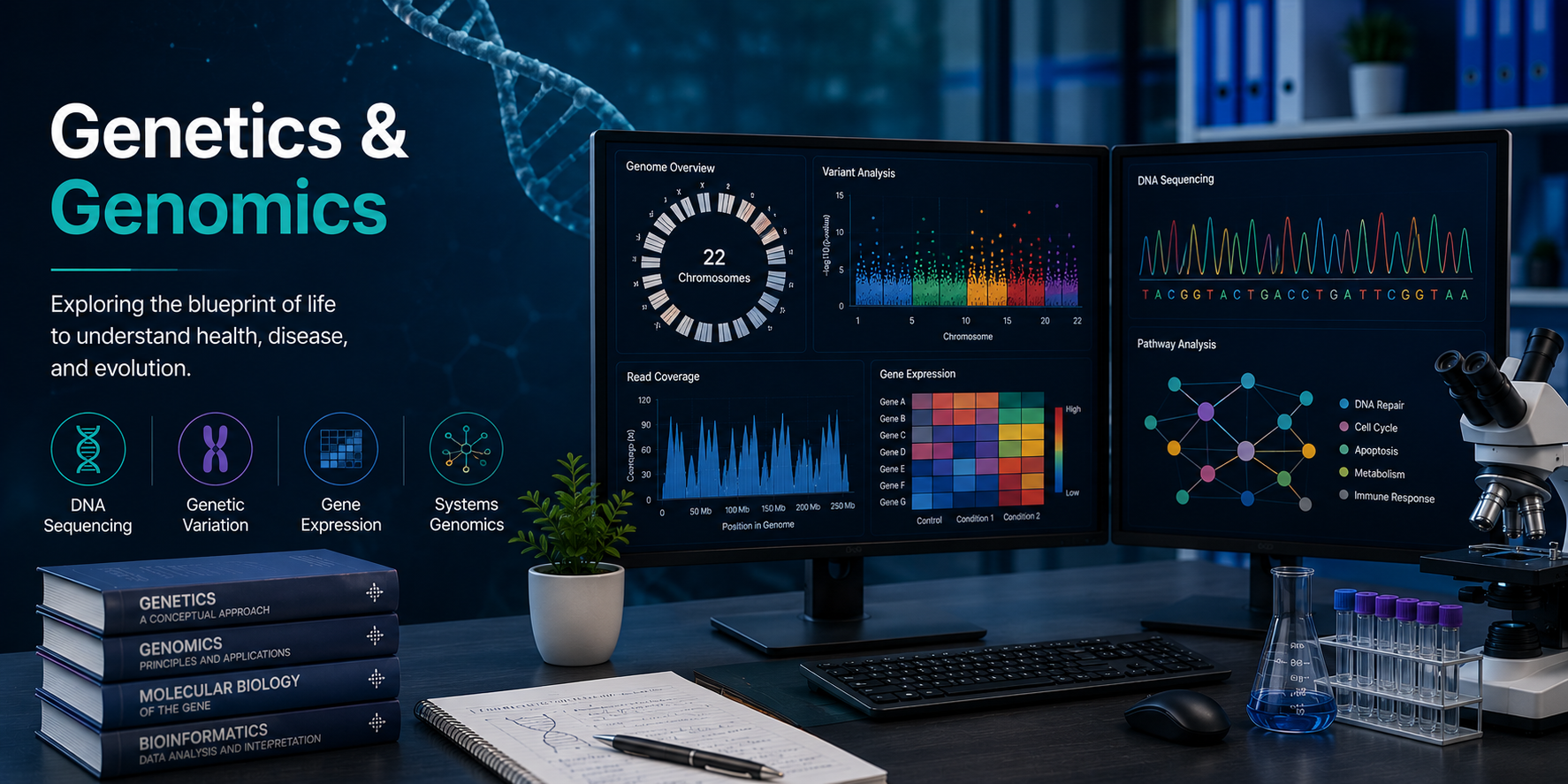
Genetics and genomics sit at the heart of modern biomedical research. From identifying rare disease-causing variants in a single family to mapping the genetic architecture of complex traits across hundreds of thousands of individuals, computational analysis is the engine that transforms sequencing data into biological insight. At BioinformaticsNext, we provide expert end-to-end bioinformatics support for genetics and genomics research — from germline variant discovery to population-scale association studies and functional annotation.
Bioinformatics for Genetics & Genomics
From single-gene disorders to genome-wide discovery — rigorous, reproducible analytics at every scale.
The falling cost of whole-genome and whole-exome sequencing has made large-scale genetic studies accessible to virtually every research group. Yet the analytical challenge has grown in proportion — variant calling, quality control, population stratification, functional annotation, and statistical association testing all require specialist expertise and validated computational infrastructure.
Our Genetics & Genomics service covers the complete analytical workflow: from raw FASTQ files through variant calling, filtering, annotation, and downstream analysis to publication-ready results. Whether you are studying Mendelian disease, complex trait genetics, population history, or the functional impact of non-coding variation, we provide the computational support to answer your research questions with confidence.
What We Analyse
Comprehensive variant and genomic profiling across all major study designs.
- Germline SNVs, indels, and structural variants in rare and common disease
- Copy-number variants (CNVs) and chromosomal rearrangements
- Genome-wide association study (GWAS) signals and fine-mapped causal variants
- Polygenic risk scores (PRS) and multi-trait genetic architecture
- Population structure, ancestry inference, and demographic history
- Linkage disequilibrium, haplotype phasing, and identity-by-descent
- Functional annotation of variants — regulatory, coding, and non-coding
- Pharmacogenomics and drug response variant profiling
Our Genetics & Genomics Services
End-to-end support across rare disease, common trait, and population genomics.
Each service is built on validated, peer-reviewed pipelines and tailored to your specific research question, cohort design, and downstream application.
1. Germline Variant Calling & Analysis WGS · WES · Panel
Accurate detection and interpretation of germline variants is the foundation of genetic research. Our germline analysis service delivers a clinically annotated variant landscape from raw sequencing reads, following GATK best-practice guidelines throughout.
- Raw read QC & preprocessing — FastQC, Trimmomatic, fastp; adapter trimming and quality filtering across all platforms
- Reference alignment — BWA-MEM2 with GATK BaseRecalibration, duplicate marking, and post-alignment QC
- SNV & indel calling — GATK HaplotypeCaller in GVCF mode; joint genotyping across cohorts; VQSR filtering
- Structural variant detection — DELLY, Manta, LUMPY, and GRIDSS; ensemble SV calling with population-level filtering
- CNV analysis — GATK gCNV, CNVnator, and ExomeDepth; copy-number profiling with segmentation and visualisation
- Variant annotation — VEP, ANNOVAR, and SnpEff against ClinVar, gnomAD, OMIM, HGMD, and UniProt
- Pathogenicity classification — ACMG/AMP criteria-based classification; CADD, REVEL, AlphaMissense, and SpliceAI scoring
- Mitochondrial variant calling — Mutect2 in mitochondrial mode; heteroplasmy estimation and haplogroup assignment
2. Rare Disease & Mendelian Genetics Trio · Family · Singleton
Rare disease diagnosis requires specialist filtering strategies, inheritance-aware analysis, and deep functional annotation. We support trio-based, family-based, and singleton analyses across WGS, WES, and gene panel data.
- Inheritance-mode filtering — Autosomal dominant, recessive, X-linked, de novo, and compound heterozygous variant filtering
- De novo variant detection — High-sensitivity trio-based calling with parental validation and population frequency filtering
- Gene panel analysis — Virtual gene panel application across any disease category using PanelApp and custom gene lists
- Phenotype-driven prioritisation — HPO term-based variant ranking with Exomiser, LIRICAL, and PhenIX
- Repeat expansion detection — ExpansionHunter, STRipy, and TRGT for known and novel repeat loci
- Mitochondrial disease analysis — Full mtDNA variant profiling including heteroplasmy and nuclear mitochondrial DNA (NUMT) filtering
- Candidate gene reports — Clinical-grade written interpretation with functional evidence, population frequency, and literature review
3. Genome-Wide Association Studies (GWAS) SNP Array · WGS · Imputation
GWAS remains the most powerful approach for identifying common genetic variants associated with complex traits and diseases. We support the full GWAS pipeline — from genotyping array QC through genome-wide testing to functional follow-up and replication.
- Genotyping array QC — Sample and variant-level QC: call rate, heterozygosity, sex check, relatedness, batch effects
- Population stratification — PCA with 1000 Genomes reference panels; ancestry inference and stratification correction
- Imputation — TOPMed, HRC, and 1000G reference panels via Michigan and TOPMed imputation servers; post-imputation QC
- Association testing — PLINK2, REGENIE, and SAIGE for binary and quantitative traits; mixed model correction for relatedness
- Meta-analysis — METAL and GWAMA for multi-cohort fixed- and random-effects meta-analysis
- Fine-mapping — FINEMAP, SuSiE, and PAINTOR for credible set construction and causal variant prioritisation
- Conditional analysis — GCTA-COJO for stepwise conditional analysis at associated loci
- Manhattan and QQ plots — Publication-ready visualisation with genome-wide significance thresholds and regional association plots (LocusZoom)
4. Polygenic Risk Scores (PRS) PRS-CS · LDpred2 · PRSice
Polygenic risk scores aggregate the combined effect of thousands of common variants to estimate an individual's genetic predisposition to a trait or disease. We provide PRS construction, validation, and clinical translation services for research and translational applications.
- PRS construction — PRSice-2, LDpred2, PRS-CS, and lassosum2 across multiple shrinkage and Bayesian methods
- LD reference panel selection — Population-matched LD reference construction and validation
- Cross-ancestry PRS — Multi-ancestry PRS development with CT-SLEB, PRS-CSx, and PRSmix for diverse populations
- Predictive performance evaluation — AUC, C-statistic, R², and incremental prediction over clinical risk factors
- PRS percentile stratification — High-risk individual identification; calibration and reclassification analyses
- PRS-by-environment interaction — Gene-environment interaction testing for lifestyle and environmental modifiers
5. Population Genetics & Ancestry Analysis Admixture · IBD · Demography
Understanding the genetic structure of populations is fundamental to both basic research and clinical genomics. We provide comprehensive population genetics services — from ancestry inference and admixture analysis to demographic modelling and phylogenetics.
- Ancestry inference — PCA-based and ADMIXTURE-based global and continental ancestry assignment
- Admixture analysis — ADMIXTURE and STRUCTURE for fine-scale population structure at varying K
- Identity-by-descent (IBD) — KING, IBDseq, and hap-IBD for relatedness estimation, cryptic relatedness detection, and IBD segment sharing
- Haplotype phasing — SHAPEIT5 and Beagle 5.4 statistical phasing; read-backed phasing for long-read data
- Linkage disequilibrium analysis — LD block detection, r² and D' calculation, and haplotype block visualisation
- Demographic inference — PSMC, SMC++, and fastsimcoal2 for effective population size history reconstruction
- Selection scans — Fst, XP-EHH, iHS, and nSL for signals of natural selection and selective sweeps
- Phylogenetic analysis — Maximum likelihood and Bayesian phylogeny construction; TreeMix for admixture graph inference
6. Functional Genomics & Variant Annotation eQTL · Regulatory · Splicing
Identifying a variant is only half the story — understanding its functional consequence is what drives biological and clinical insight. We provide deep functional annotation and regulatory genomics analysis to interpret the impact of genetic variation.
- eQTL mapping — Matrix-eQTL, FastQTL, and tensorQTL for cis- and trans-eQTL discovery; GTEx and eQTL Catalogue integration
- Splicing QTL (sQTL) — LeafCutter and FRASER for splicing variation linked to genetic variants
- Colocalisation analysis — COLOC and HyPrColoc for shared causal variant testing between GWAS and QTL signals
- Mendelian randomisation — Two-sample MR with TwoSampleMR and MendelianRandomization; sensitivity analyses (MR-Egger, weighted median, MR-PRESSO)
- Regulatory element annotation — ENCODE, Roadmap, and FANTOM5 regulatory feature overlap; activity-by-contact (ABC) model scoring
- Transcription factor binding disruption — JASPAR motif scanning; SNP-disrupted TF binding site prediction
- Protein effect prediction — AlphaFold2 structural impact modelling; PolyPhen-2, SIFT, and CADD for coding variant effect prediction
7. Pharmacogenomics PGx · Drug Response · CPIC
Pharmacogenomics identifies how an individual's genetic makeup influences their response to drugs — enabling safer prescribing, personalised dosing, and the avoidance of adverse drug reactions. We provide research-grade and translational PGx analysis services.
- Star allele calling — Cyrius, Stargazer, and PharmCAT for CYP2D6, CYP2C19, CYP2C9, DPYD, TPMT, and 25+ genes
- Diplotype and phenotype assignment — CPIC guideline-compliant metaboliser status (PM, IM, NM, UM) for all major PGx genes
- GWAS for drug response — Association analysis for drug efficacy, toxicity, and adverse event endpoints
- HLA typing — OptiType and HLA-HD high-resolution HLA typing from WGS/WES for abacavir, carbamazepine, and other HLA-associated reactions
- PGx variant annotation — PharmGKB, CPIC, DPWG, and FDA drug labelling cross-referencing
- PGx report generation — Structured clinical PGx reports summarising metaboliser status, clinical implications, and prescribing recommendations
8. Long-Read & Third-Generation Sequencing PacBio · Oxford Nanopore
Long-read sequencing technologies from PacBio (HiFi/CCS) and Oxford Nanopore Technologies resolve structural variants, repeat expansions, and complex genomic regions inaccessible to short-read platforms — providing a complete view of the genome.
- Long-read alignment — minimap2 and pbmm2 for PacBio HiFi and ONT data alignment to reference genomes
- Variant calling — DeepVariant (HiFi), Clair3, and PEPPER-Margin-DeepVariant for SNV and indel detection
- SV detection — PBSV, Sniffles2, and cuteSV for long-read structural variant discovery with breakpoint resolution
- Repeat expansion genotyping — TRGT and Straglr for precise repeat length and composition measurement
- Haplotype-resolved assembly — Hifiasm and verkko for phased diploid genome assembly; assembly QC with QUAST and Merqury
- Methylation calling — Modkit and Dorado for CpG methylation from ONT data; integrated phasing and methylation analysis
- Telomere and centromere analysis — T2T-CHM13 reference-based repeat region characterisation and variant calling
Key Applications
Research and clinical translation applications across the full genetics spectrum.
- Rare disease diagnosis and candidate gene discovery
- GWAS for complex traits and common disease
- Polygenic risk score development and validation
- Population structure and ancestry inference
- Pharmacogenomics and precision prescribing
- eQTL mapping and GWAS colocalisation
- Mendelian randomisation and causal inference
- Repeat expansion and structural variant discovery
- Long-read phased genome assembly
- Functional annotation and regulatory variant interpretation
Disease Areas & Traits We Support
Direct analytical experience across Mendelian and complex disease genetics.
- Intellectual disability and neurodevelopmental disorders
- Primary immunodeficiencies and autoinflammatory disease
- Hereditary cardiomyopathies and channelopathies
- Rare skeletal and connective tissue disorders
- Inborn errors of metabolism
- Hereditary cancer syndromes (BRCA1/2, Lynch, Li-Fraumeni)
- Mitochondrial disease and mtDNA disorders
- Undiagnosed disease programmes
- Cardiovascular disease, hypertension, and lipid traits
- Type 2 diabetes, obesity, and metabolic syndrome
- Psychiatric disorders (schizophrenia, bipolar, depression, ASD)
- Inflammatory and autoimmune disease (IBD, RA, SLE, MS)
- Neurodegenerative disease (Alzheimer's, Parkinson's)
- Anthropometric and biomarker traits (BMI, height, blood counts)
- Cancer predisposition and familial aggregation
- Drug response and pharmacogenomic traits
Our Analytical Workflow
A rigorous, reproducible process from raw data to publication-ready results.
Step 1 — Project Scoping Free
Consultation to define your research question, cohort design, variant types of interest, and deliverables. We assess data quality, sequencing depth, sample size, and statistical power requirements.
Step 2 — Data Receipt & QC
Secure, encrypted data transfer and storage. Comprehensive QC reporting (FastQC, MultiQC, Picard metrics) and cohort-level QC before analysis begins.
Step 3 — Pipeline Configuration
Selection and version-controlled configuration of validated variant calling or association analysis pipelines matched to your data type, study design, and analytical goal.
Step 4 — Primary Analysis
Alignment, variant calling, joint genotyping, imputation, or association testing as appropriate. All steps logged and reproducible via Snakemake / Nextflow.
Step 5 — Statistical Analysis
Variant filtering, inheritance analysis, association testing, fine-mapping, PRS construction, or population stratification using appropriate frameworks for your study design.
Step 6 — Functional Annotation
Deep variant annotation against clinical, population, and functional databases. Pathogenicity classification, regulatory impact scoring, and literature-based evidence synthesis.
Step 7 — Interpretation & Report
A structured written report covering methods, results, biological interpretation, variant classifications, limitations, and recommended follow-up experiments or validation studies.
Step 8 — Manuscript Support Optional
Methods section drafting, figure legends, supplementary table preparation, and response to peer-reviewer bioinformatics comments.
Tools & Technologies
Industry-standard, peer-reviewed tools across all genetics and genomics pipelines.
- Alignment: BWA-MEM2, minimap2, pbmm2, STAR
- SNV/Indel Calling: GATK HaplotypeCaller, DeepVariant, Clair3
- SV Calling: DELLY, Manta, LUMPY, PBSV, Sniffles2
- CNV Analysis: GATK gCNV, CNVnator, ExomeDepth
- Repeat Expansions: ExpansionHunter, TRGT, STRipy
- Variant Annotation: VEP, ANNOVAR, SnpEff, PharmCAT
- Rare Disease: Exomiser, LIRICAL, PhenIX
- GWAS: PLINK2, REGENIE, SAIGE, METAL, GWAMA
- Fine-mapping: FINEMAP, SuSiE, PAINTOR, GCTA-COJO
- PRS: PRSice-2, LDpred2, PRS-CS, PRS-CSx
- Population Genetics: ADMIXTURE, KING, SHAPEIT5, Beagle
- Functional Genomics: FastQTL, COLOC, TwoSampleMR
- Assembly: Hifiasm, verkko, QUAST, Merqury
- Workflow Management: Snakemake, Nextflow, CWL
Public Databases & Reference Resources
All major genetics databases for contextualising and benchmarking your findings.
- gnomAD v4 — Population allele frequencies across 730,000+ exomes and genomes; constraint metrics for gene-level burden analysis
- ClinVar — Clinically interpreted variants; pathogenicity classifications from diagnostic laboratories worldwide
- OMIM — Gene–disease relationships and molecular basis of Mendelian disorders
- HGMD Professional — Human Gene Mutation Database for known disease-causing variants
- UK Biobank / FinnGen / UKBB-PPP — Large-scale GWAS summary statistics and PRS reference datasets
- GTEx v10 — Tissue-specific eQTL data for variant-gene expression colocalisation
- 1000 Genomes & TOPMed — Population reference panels for imputation and ancestry inference
- ENCODE / Roadmap Epigenomics — Regulatory element annotations for non-coding variant interpretation
- PharmGKB / CPIC / DPWG — Pharmacogenomics variant-drug associations and prescribing guidelines
- ClinGen — Expert-curated gene–disease validity classifications and variant interpretation guidelines
Project Deliverables
Standardised, structured outputs supporting publications, clinical decisions, and grant applications.
- Quality control report (MultiQC HTML + PDF) covering all samples
- Processed data files: aligned BAMs, filtered VCFs, annotated variant tables
- Annotated results tables (TSV / Excel) with pathogenicity scores and database cross-references
- Publication-ready figures (PDF, SVG, PNG at 300 dpi)
- Full written report: methods, results, interpretation & recommendations
- Pipeline scripts and configuration files for full reproducibility
- Post-delivery consultation call for results walkthrough and Q&A
- Clinical-grade variant interpretation reports (ACMG/AMP formatted)
- Manuscript methods section and figure legends (journal-formatted)
- Supplementary data tables and extended figure sets
- Custom R Shiny or Python Dash interactive variant explorer
- Training and knowledge transfer sessions for your team
- Long-term retainer support for ongoing projects
- Response to peer-reviewer bioinformatics comments
Why Choose BioinformaticsNext?
Deep genetics expertise, validated pipelines, and a commitment to reproducible science.
Genetics Domain Expertise
Our analysts hold advanced degrees in human genetics, computational biology, and genomic medicine. We understand the clinical significance of variant interpretation, not just the computational steps.
End-to-End Service
From raw FASTQ to annotated variant report or GWAS summary statistics — every step handled in-house, eliminating the need for your own bioinformatics infrastructure.
GATK Best-Practice Pipelines
All germline workflows follow GATK best-practice guidelines. GWAS pipelines follow published QC standards from major biobank consortia. Every tool version is recorded.
Fast Turnaround
Most projects are delivered within 2–4 weeks. Rush turnarounds are available for grant deadlines, clinical timelines, and conference submissions.
Flexible Engagement
Project-based, hourly, or long-term retainer arrangements. We scale to your timeline, cohort size, and budget with no minimum commitment.
Data Security & Compliance
Encrypted data transfer and storage. GDPR-compliant Data Processing Agreements and NDAs available upon request. Human genomic data handled under strict governance.
Manuscript Track Record
We have contributed to peer-reviewed publications in genetics and genomics and support researchers through the full submission and revision process.
Global Reach
UK-headquartered with clients across Europe, North America, the Middle East, and Asia-Pacific. Remote collaboration supported across all time zones.
Frequently Asked Questions
Common questions from genetics and genomics clients.
For whole-genome sequencing, 30× coverage is the standard minimum for germline SNV and indel calling; 60× is recommended for structural variant discovery and repeat analysis. For whole-exome sequencing, 100× mean on-target coverage is standard. For gene panels, 200–500× is typically required. We advise on sequencing strategy during the free scoping call.
Yes. We support data from Illumina (NovaSeq, NextSeq, MiSeq), PacBio (HiFi/CCS, CLR), and Oxford Nanopore Technologies (R10 flow cells, PromethION). We also analyse genotyping array data from Illumina and Affymetrix platforms and can access publicly available datasets from GEO, SRA, dbGaP, and EGA on your behalf.
Meaningful GWAS power for common variants (MAF > 5%) typically requires at minimum several thousand samples for moderate effect sizes. We perform power calculations during project scoping and advise on the minimum sample size required to detect variants of the expected effect size in your trait of interest. We also support meta-analysis strategies to combine your cohort with publicly available summary statistics.
Yes. For rare disease and clinical genomics projects, we provide structured variant interpretation reports applying ACMG/AMP classification criteria (pathogenic, likely pathogenic, variant of uncertain significance, likely benign, benign). These reports include population frequency, in silico prediction scores, functional evidence, and literature-based evidence synthesis.
Yes. We have experience working with UK Biobank, FinnGen, deCODE, and other large biobank datasets. We can assist with data access applications, analysis within approved research environments (UKB Research Analysis Platform), and integration of biobank GWAS results with your own cohort data for meta-analysis or PRS validation.
Absolutely. We assist with the bioinformatics and statistical genetics sections of grant applications — including power calculations, proposed analytical workflows, preliminary data generation, and budget justification for computational resources. Please contact us as early as possible in the grant preparation process.
Related Research Areas & Services
Genetics and genomics intersects with multiple other research domains we support.
- Cancer & Oncogenomics — Somatic variant analysis, tumour heterogeneity, and cancer genome profiling for oncology research
- Immunology & Immuno-Oncology — Genetic basis of immune disorders, HLA analysis, and immune GWAS
- Neuroscience & CNS Genomics — Rare and common variant genetics of neurodevelopmental and neurodegenerative disease
- Metabolism & Endocrinology — Genetic architecture of metabolic traits and endocrine disorders
- Custom Software & Pipeline Development — Bespoke variant analysis platforms, clinical reporting tools, and automated pipeline deployment
Ready to Advance Your Genetics Research?
Tell us about your cohort, your research question, and the data you have in hand. Our genetics and genomics team will design a tailored analytical plan — typically within 48 hours of your enquiry. Whether you are diagnosing a rare disease, planning a GWAS, or building a polygenic risk score, we are here to help from day one.