
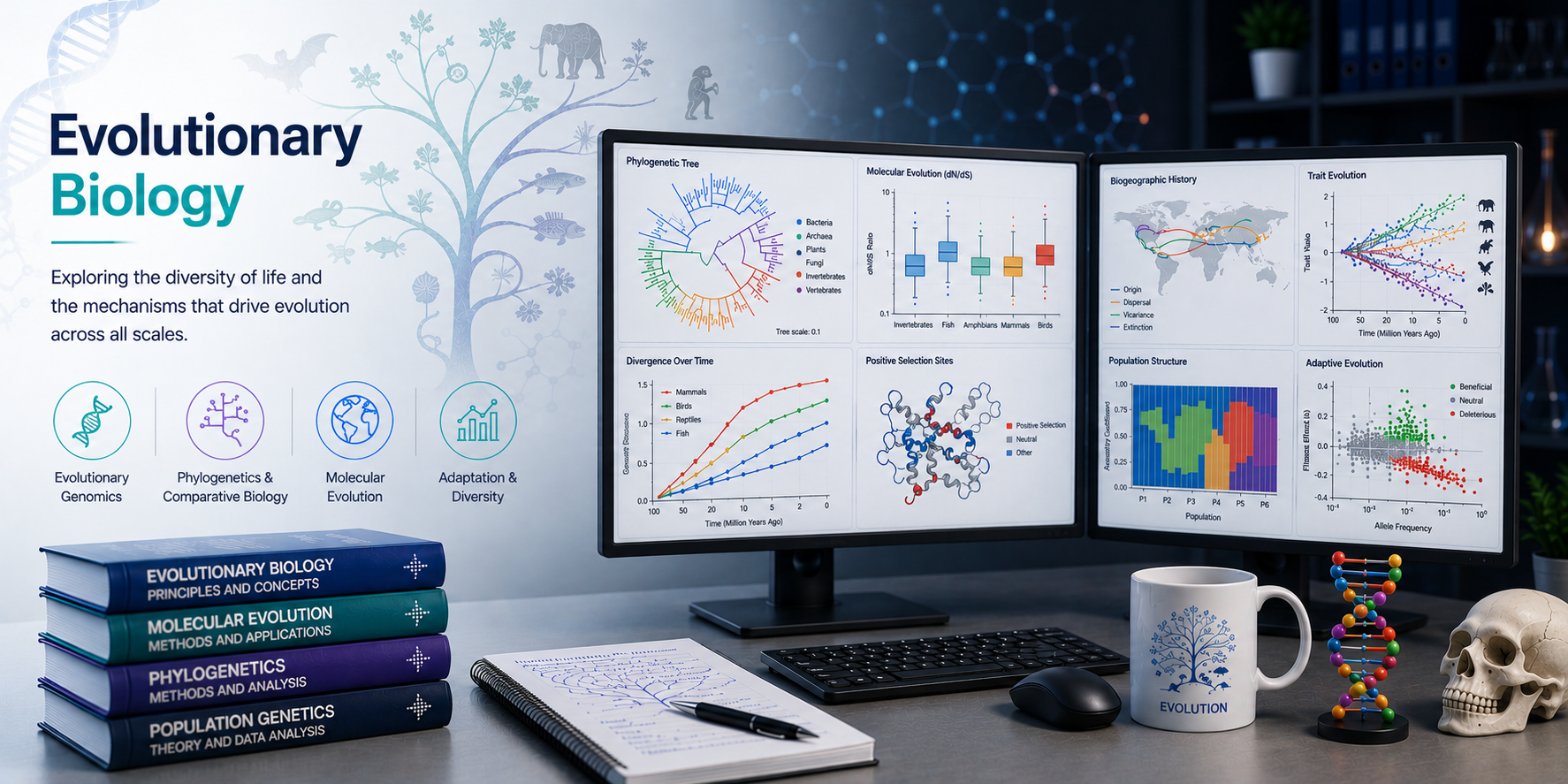
Evolutionary biology is the foundation of all life sciences — providing the framework for understanding how organisms diversify, adapt, and change through time. From reconstructing the deep evolutionary history of species to tracking pathogen evolution in real time, from identifying the genomic signatures of natural selection to understanding how populations respond to environmental pressures, evolutionary biology research is increasingly powered by high-throughput sequencing and sophisticated computational analysis. At BioinformaticsNext, we provide expert bioinformatics support for evolutionary biology research — helping scientists extract meaningful evolutionary insight from genomic, transcriptomic, and population-level data.
Bioinformatics for Evolutionary Biology
From deep phylogenomics to real-time pathogen surveillance — rigorous evolutionary analytics at every scale.
The genomics revolution has transformed evolutionary biology. Whole-genome sequencing of populations, ancient DNA analysis, comparative genomics across hundreds of species, and real-time pathogen surveillance have all become routine — generating datasets of enormous scale and complexity. Extracting meaningful evolutionary signal from this data requires specialised computational tools, rigorous statistical methods, and deep biological understanding.
At BioinformaticsNext, we provide validated, publication-grade bioinformatics pipelines for the full spectrum of evolutionary biology research — from phylogenomics and population genetics to molecular evolution and adaptive genomics — supporting studies in humans, animals, plants, fungi, bacteria, and viruses.
What We Analyse
Comprehensive evolutionary analysis across phylogenetics, population genomics, selection, and molecular evolution.
- Phylogenetic relationships among species, populations, or strains from genomic data
- Population genetic structure, admixture, and demographic history
- Signatures of natural selection — positive, purifying, and balancing selection
- Molecular evolution rates, substitution patterns, and divergence times
- Gene family evolution — duplication, loss, and functional diversification
- Horizontal gene transfer and genomic island identification in microbes
- Ancient DNA and palaeogenomics for deep historical reconstruction
- Convergent evolution and parallel molecular adaptation across lineages
Our Evolutionary Biology Services
Comprehensive bioinformatics support across the full range of evolutionary biology research questions and data types.
All pipelines follow published best-practice guidelines and are version-controlled for full reproducibility.
1. Phylogenetics & Phylogenomics IQ-TREE2 · BEAST2 · ASTRAL-III · ggtree
Reconstructing accurate evolutionary relationships is fundamental to evolutionary biology. Our phylogenetics service covers the complete workflow from sequence alignment to tree inference, time calibration, and publication-ready visualisation — supporting gene-level, multi-gene, and whole-genome phylogenetic analyses.
- Multiple sequence alignment — MUSCLE, MAFFT, ClustalOmega, and PRANK for nucleotide and protein sequence alignment; alignment trimming and filtering with trimAl and Gblocks
- Maximum likelihood phylogenetics — IQ-TREE2 with automatic model selection (ModelFinder); ultrafast bootstrap (UFBoot2) and SH-aLRT branch support; RAxML-NG for large-scale datasets
- Bayesian phylogenetics — MrBayes and BEAST2 for posterior probability-supported tree inference; convergence diagnostics with Tracer and RWTY
- Whole-genome phylogenomics — Concatenation and coalescent-based species tree inference (ASTRAL-III) from genome-wide SNP or gene tree datasets; handling of incomplete lineage sorting
- Core genome phylogenies for bacteria — SNP-based phylogenies from core-genome alignments using Snippy, Parsnp, and Roary; outbreak cluster analysis and transmission tree reconstruction
- Network phylogenetics — SplitsTree and PopART for phylogenetic network construction; reticulate evolution and hybridisation detection
- Tree visualisation & annotation — Publication-ready phylogenetic trees with iTOL, FigTree, and ggtree; annotation with trait data, geographic distribution, resistance genes, and metadata overlays
2. Molecular Clock & Divergence Time Estimation BEAST2 · TreeTime · LSD2 · TempEst
Placing evolutionary events in geological time — estimating when lineages diverged, when traits emerged, and when populations expanded — requires molecular clock analysis with appropriate calibration. We provide rigorous time-calibrated phylogenetic analysis for both deep and recent evolutionary questions.
- Bayesian molecular clock analysis — BEAST2 for time-calibrated phylogenies; strict, relaxed uncorrelated lognormal, and relaxed exponential clock models; fossil and biogeographic calibration prior specification
- TreeTime & LSD2 — Rapid least-squares dating for large viral and bacterial datasets; temporal signal assessment with root-to-tip regression analysis
- Substitution rate estimation — Site-specific and gene-specific substitution rate inference; rate variation across lineages and partitions
- Ancient DNA molecular clock calibration — Tip-dating approaches using radiocarbon-dated ancient samples; ancient DNA damage pattern modelling with mapDamage2
- Temporal signal testing — Clock-likeness assessment with TempEst; date randomisation tests for phylogenetic temporal signal validation
3. Population Genetics & Population Genomics ADMIXTURE · PSMC · MSMC2 · FST · IBD
Population genetics provides the quantitative framework for understanding genetic diversity, demographic history, gene flow, and the forces shaping allele frequency distributions within and between populations. Our population genomics service supports both human and non-human population studies across a wide range of research questions.
- Population structure analysis — Principal component analysis (PCA) with flashPCA and PLINK2; model-based clustering with ADMIXTURE and STRUCTURE; discriminant analysis of principal components (DAPC)
- Genetic diversity statistics — Nucleotide diversity (π), Watterson's θ, Tajima's D, and Fst in sliding windows with VCFtools, PopLDdecay, and pixy
- FST-based differentiation — Pairwise Fst estimation between populations; outlier locus detection for local adaptation; BayeScan and OutFLANK for selection-driven differentiation
- Demographic history inference — PSMC and MSMC2 for effective population size (Ne) reconstruction through time from diploid whole-genome sequences; SMC++ for population size inference from multiple sequences
- Admixture and gene flow — D-statistics (ABBA-BABA) and f-statistics (f3, f4) for admixture testing; TreeMix for population graph modelling with migration edges; qpAdm for admixture proportion estimation
- Identity-by-descent (IBD) analysis — IBD segment detection with GERMLINE, hap-IBD, and RefinedIBD; relatedness estimation across large cohorts; IBD-based demographic inference
- Linkage disequilibrium analysis — LD decay, haplotype block structure, and tagging SNP identification; long-range LD and selective sweep detection
4. Natural Selection Analysis selscan · PAML · HyPhy · dN/dS · MK Test
Identifying genomic regions and genes shaped by natural selection is central to evolutionary biology — revealing the molecular basis of adaptation, the functional importance of conserved sequences, and the evolutionary forces driving phenotypic diversification. We provide comprehensive selection analysis at both population and molecular levels.
- Positive selection scans — population level — Extended haplotype homozygosity (EHH), iHS, XP-EHH, and nSL statistics with selscan; composite likelihood ratio (CLR) tests with SweeD and SweepFinder2
- Population branch statistics — PBS (Population Branch Statistic) for identifying population-specific selective sweeps; XP-CLR for cross-population extended haplotype tests
- dN/dS ratio analysis — PAML (codeml) for codon model-based dN/dS estimation; branch, site, and branch-site models; HyPhy BUSTED, MEME, and FEL for episodic and pervasive selection
- McDonald-Kreitman test — MK test and extensions (asymptotic MK, DoFE) for estimating the proportion of adaptive evolution (alpha) in protein-coding genes
- Balancing selection detection — Beta statistics, Tajima's D-based tests, and long-term balancing selection detection with BalLeRMix and NCD statistics
- Constraint and conservation analysis — PhyloP and GERP++ evolutionary constraint scores; identification of ultra-conserved elements and their functional significance
5. Comparative Genomics OrthoFinder · CAFE5 · MCScanX · Synteny
Comparing genomes across species, strains, or populations reveals the genetic basis of phenotypic diversity, the evolution of gene families, and the functional significance of conserved and divergent genomic regions. Our comparative genomics service supports both pairwise and large-scale multi-genome studies.
- Whole-genome alignment — LASTZ, MUMmer4, and minimap2 for pairwise genome alignment; MULTIZ and Progressive Mauve for multiple genome alignment across species
- Synteny analysis — Collinearity and chromosomal rearrangement detection with MCScanX, SynMap, and JCVI; synteny block visualisation with Circos and SynVisio
- Ortholog and gene family analysis — OrthoFinder for ortholog group inference across species; gene family size evolution modelling with CAFE5; duplication and loss rate estimation
- Gene gain and loss analysis — Dollo parsimony and probabilistic models for ancestral gene content reconstruction; core / accessory genome analysis
- Transposable element analysis — RepeatMasker and RepeatModeler for TE annotation and classification; TE insertion polymorphism analysis and TE-driven regulatory innovation
- Genome size and karyotype evolution — Polyploidy detection and whole-genome duplication (WGD) analysis; chromosome-scale synteny and evolutionary karyotyping
6. Phylogeography & Molecular Epidemiology BEAST2 · Pangolin · Nextclade · Phylodynamics
Phylogeography links evolutionary history to geography — reconstructing how species, populations, and pathogens have spread across landscapes and through time. Molecular epidemiology applies these tools to track infectious disease transmission and outbreak dynamics.
- Phylogeographic analysis — Discrete and continuous trait phylogeography with BEAST2; ancestral state reconstruction of geographic location; migration rate estimation between regions
- Phylodynamics — Effective population size (Ne) through time from genomic data using coalescent and birth-death models in BEAST2; epidemic growth rate inference
- Transmission cluster analysis — SNP-distance-based clustering; minimum spanning tree and transmission network reconstruction for outbreak investigation
- Viral phylodynamics — SARS-CoV-2, influenza, HIV, dengue, and other viral phylodynamic analysis; lineage assignment with Pangolin and Nextclade; genomic surveillance pipeline support
- Landscape genetics — Isolation-by-distance and isolation-by-resistance modelling; landscape feature effects on gene flow; EEMS for effective migration surface estimation
7. Ancient DNA & Palaeogenomics mapDamage2 · ANGSD · qpAdm · AADR
Ancient DNA analysis opens a direct window into the past — enabling the reconstruction of ancestral populations, the tracking of migrations and admixture events, and the identification of evolutionary changes over archaeological and geological timescales.
- Ancient DNA damage assessment — mapDamage2 for C-to-T and G-to-A damage pattern quantification and rescaling; authentication of ancient DNA authenticity
- aDNA-specific alignment — BWA aln with ancient DNA parameters; strict duplicate removal; contamination estimation with ANGSD and ContamMix
- Genotype likelihood-based analysis — ANGSD for genotype likelihood estimation and population genetics without hard genotype calling; suitable for low-coverage ancient DNA
- Population history with ancient samples — qpAdm and qpGraph for admixture modelling with ancient reference panels; integration with the Allen Ancient DNA Resource (AADR)
- Palaeogenomic sex determination & kinship — Biological sex inference from X/Y chromosome coverage; kinship coefficient estimation with READ and KIN
Key Applications
Research applications across taxa, timescales, and biological questions in evolutionary biology.
- Species and population phylogenomics
- Adaptive evolution and positive selection mapping
- Human population history and ancient migrations
- Pathogen outbreak genomics and transmission tracking
- Conservation genomics and endangered species management
- Crop and livestock evolutionary genomics and domestication
- Gene family expansion and functional diversification
- Viral and bacterial molecular epidemiology
- Convergent evolution and molecular parallelism
- Palaeogenomics and ancient population reconstruction
- Coevolution of hosts and parasites or symbionts
- Comparative transcriptomics and expression evolution
Our Analytical Workflow
A structured, reproducible process from initial data assessment to final interpreted results and written report.
Step 1 — Project Scoping Free
We discuss your study organisms, data type, evolutionary question, and research goals to define the most appropriate analytical approach and deliverables.
Step 2 — Data Receipt & QC
Secure encrypted data transfer; comprehensive QC (FastQC, MultiQC) and ancient DNA damage assessment where applicable before analysis begins.
Step 3 — Pipeline Configuration
Version-controlled pipeline setup with Snakemake or Nextflow; tool and database selection matched to your data type and evolutionary question.
Step 4 — Primary Analysis
Alignment, variant calling, sequence alignment, or genome assembly as appropriate; all intermediate files retained for full auditability.
Step 5 — Evolutionary Analysis
Phylogenetic inference, population structure, selection scans, divergence time estimation, or demographic modelling depending on project type.
Step 6 — Statistical Testing
Appropriate statistical frameworks for your evolutionary question; bootstrap support, Bayesian posterior probabilities, or permutation-based significance testing.
Step 7 — Visualisation
Publication-ready figures — phylogenetic trees, PCA biplots, selection scan Manhattan plots, demographic history plots, synteny diagrams, and admixture bar charts.
Step 8 — Report & Manuscript Support Optional
Full written report with methods, results, and biological interpretation; optional manuscript methods section and figure legend preparation.
Tools & Technologies
Validated, peer-reviewed, and actively maintained tools across all evolutionary biology pipelines.
- Alignment: MAFFT, MUSCLE, ClustalOmega, PRANK, trimAl
- ML Phylogenetics: IQ-TREE2, RAxML-NG, FastTree2
- Bayesian Phylogenetics: MrBayes, BEAST2, RevBayes
- Species Trees: ASTRAL-III, SVDquartets, SNAPP
- Molecular Clock: BEAST2, TreeTime, LSD2, TempEst
- Population Genetics: PLINK2, ADMIXTURE, flashPCA, VCFtools
- Demographic Inference: PSMC, MSMC2, SMC++, fastsimcoal2
- Selection Analysis: selscan, SweeD, PAML, HyPhy, BayeScan
- Admixture & Gene Flow: ADMIXTURE, TreeMix, qpAdm, D-statistics
- Comparative Genomics: OrthoFinder, MCScanX, MUMmer4, CAFE5
- Ancient DNA: mapDamage2, ANGSD, BWA aln, READ
- Phylogeography: BEAST2 phylogeography, EEMS, BioGeoBEARS
- Visualisation: ggtree, iTOL, FigTree, PopART, ggplot2
- Workflow: Snakemake, Nextflow, CWL
Reference Databases & Resources We Use
All major evolutionary biology and comparative genomics reference resources for phylogenetic inference, population analysis, and molecular evolution studies.
- NCBI GenBank / RefSeq — Reference genome sequences, gene sequences, and annotated genomes across all domains of life for comparative and phylogenetic analyses
- Ensembl Genomes — Annotated genome assemblies for vertebrates, invertebrates, plants, fungi, bacteria, and protists; ortholog and synteny data
- 1000 Genomes Project — Human population genomics reference panel for population structure, admixture, and variant frequency benchmarking
- Allen Ancient DNA Resource (AADR) — Curated ancient human and other organism genomic datasets for palaeogenomic analysis
- UCSC Genome Browser / 100-way alignment — Multi-species whole-genome alignments and conservation tracks for comparative genomics and constraint analysis
- OrthoDB — Hierarchical ortholog database for gene family analysis across eukaryotes, bacteria, and viruses
- TimeTree — Molecular clock-based timetree database for divergence time reference and calibration point selection
- GISAID — Global viral genome database for SARS-CoV-2, influenza, and other viral phylodynamic and molecular epidemiology analyses
- BOLD (Barcode of Life Database) — DNA barcode reference library for species identification and barcoding-based phylogenetics
Project Deliverables
A complete, structured set of outputs ready for publication, grant submission, or downstream comparative analysis.
- Quality control report for all input sequences and samples
- Processed data files: aligned sequences, VCF files, phylogenetic trees (Newick / NEXUS), population statistics tables
- Annotated results: selection scan outputs, admixture proportions, divergence time estimates with credible intervals
- Publication-ready figures (PDF, SVG, PNG at 300 dpi)
- Full written report: methods, results, biological interpretation, and recommendations
- Pipeline scripts and configuration files for full reproducibility
- Post-delivery consultation call for results walkthrough and Q&A
- Annotated phylogenetic trees in iTOL-ready format with metadata overlays
- Interactive phylogeographic map outputs
- Manuscript methods section and figure legends (journal-formatted)
- Supplementary data tables and extended figure sets
- NCBI / GenBank sequence submission support
- Long-term retainer support for ongoing population genomics or surveillance projects
Why Choose BioinformaticsNext?
Deep expertise in molecular evolution, population genetics, and phylogenomics combined with validated, scalable pipelines — delivering results that are scientifically rigorous, reproducible, and publication-ready.
Evolutionary Biology Expertise
Our analysts understand the theory and practice of molecular evolution, population genetics, and phylogenetics — ensuring your data is interpreted with the biological and statistical rigour it deserves.
Multi-Taxon Experience
We work with humans, animals, plants, fungi, bacteria, archaea, and viruses — applying appropriate models and tools for each biological system.
End-to-End Service
From raw sequencing files to annotated phylogenies, selection statistics, and demographic models — every step handled in-house with no need for your own bioinformatics infrastructure.
Fast Turnaround
Most projects are delivered within 2–4 weeks. Rush turnarounds are available for outbreak investigations and grant deadlines.
Flexible Engagement
Project-based, hourly, or long-term retainer arrangements tailored to your timeline and budget with no minimum commitment.
Data Security
Encrypted data transfer and storage. NDAs and GDPR-compliant Data Processing Agreements available upon request.
Reproducible Science
All pipelines are version-controlled and fully documented — ensuring your analyses meet the reproducibility standards required by leading journals.
Global Reach
UK-headquartered with clients across Europe, North America, the Middle East, and Asia-Pacific.
Frequently Asked Questions
Common questions from evolutionary biology research clients.
We work with single genes, multi-gene datasets, whole mitochondrial or chloroplast genomes, core genome SNPs, and whole nuclear genomes. The choice of data type depends on your taxonomic group, the evolutionary question, and the divergence times involved. We advise on the most appropriate approach during the free project scoping call.
Incomplete lineage sorting (ILS) is a common challenge in species-level phylogenomics, particularly in rapidly radiating groups. We use coalescent-based species tree methods such as ASTRAL-III that explicitly account for ILS by analysing gene trees rather than concatenated alignments. We also test for discordance between gene trees and the species tree to identify loci affected by ILS, hybridisation, or horizontal gene transfer.
Yes. For organisms without a reference genome, we can perform de novo genome assembly followed by comparative analysis, or use reference-free population genetics approaches based on k-mer methods and alignment-free statistics. We can also use a closely related species genome as a reference where a conspecific assembly is unavailable.
Yes. Our population genomics pipelines are designed to scale to thousands of samples using efficient tools such as PLINK2, REGENIE, fastsimcoal2, and SMC++. We use high-performance computing approaches and parallelised workflows to handle large-scale population datasets efficiently.
Yes. We support the setup and ongoing analysis of pathogen genomic surveillance pipelines — including automated lineage assignment (Pangolin, Nextclade), phylogenetic placement, outbreak cluster detection, and regular reporting dashboards. We have experience with SARS-CoV-2, influenza, Salmonella, Mycobacterium tuberculosis, and other priority pathogens.
Absolutely. We assist with the evolutionary biology and bioinformatics sections of grant applications — including study design, proposed analytical workflows, and preliminary data generation. Please get in touch as early as possible in the grant preparation process.
Related Research Areas & Services
Evolutionary biology intersects with multiple other research domains we support.
- Genetics & Genomics — Population genetics, GWAS, germline variant analysis, and phylogenetics for human and non-human genomics studies
- Microbiology & Metagenomics — Microbial genome assembly, comparative genomics, pangenome analysis, and pathogen phylodynamics
- Cancer & Oncogenomics — Tumour clonal evolution, somatic mutation accumulation, and cancer cell phylogenetic reconstruction
- Structural & Functional Genomics — Comparative epigenomics, regulatory element evolution, and transposable element biology across species
- Custom Software & Pipeline Development — Bespoke phylogenomics platforms, genomic surveillance dashboards, and automated evolutionary analysis pipeline deployment
Ready to Explore the Evolution of Life?
Tell us about your organisms, your sequencing data, and your evolutionary research questions. Our evolutionary biology team will design a tailored analytical plan — typically within 48 hours of your enquiry. Whether you are reconstructing a deep phylogeny, mapping adaptive evolution across a population, or tracking a pathogen outbreak in real time, we are here to support you from day one.