
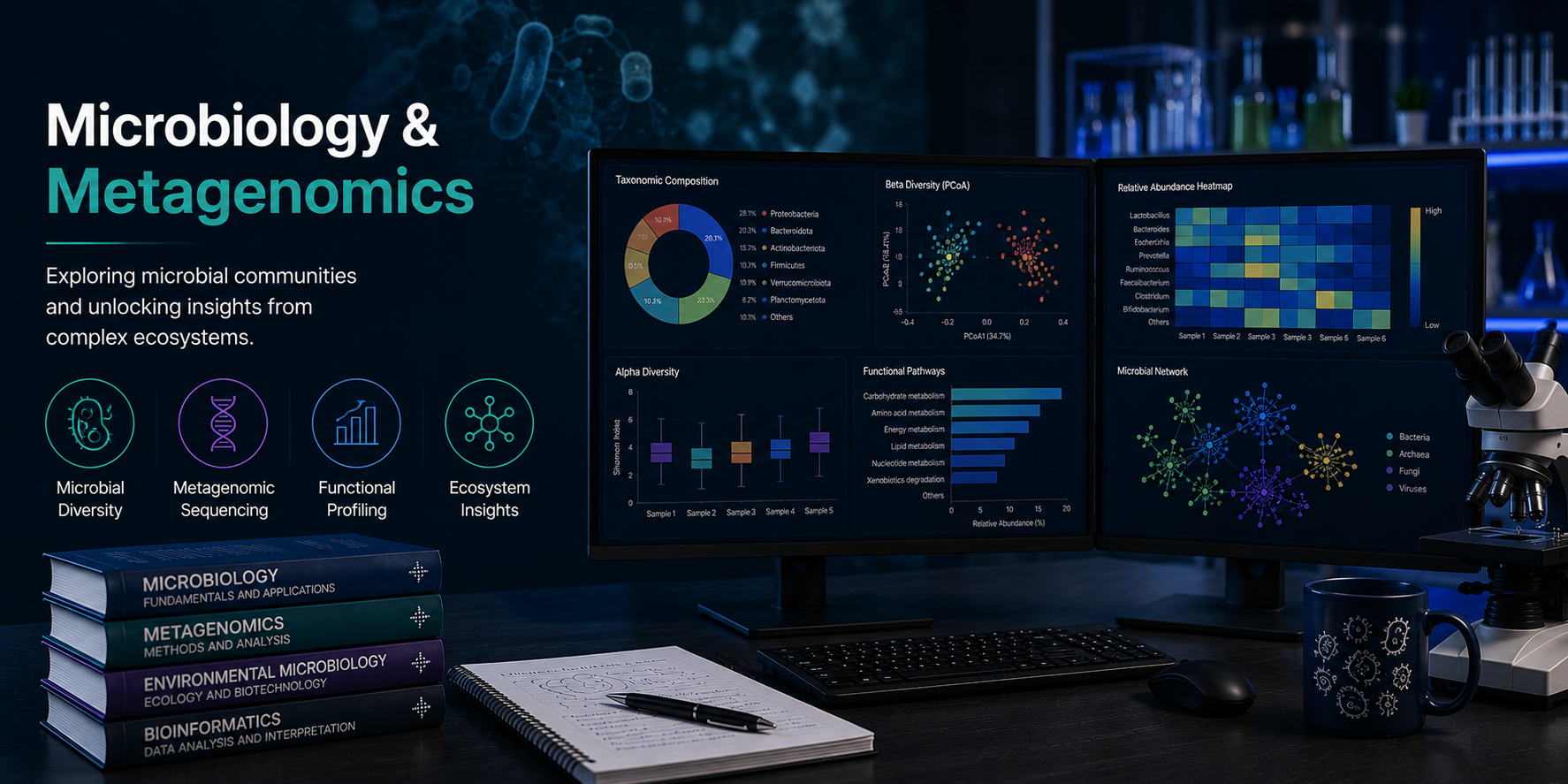
Microorganisms shape every aspect of life on Earth — from the health of the human gut to the spread of infectious disease, the cycling of nutrients in the environment, and the emergence of antimicrobial resistance. At BioinformaticsNext, we provide expert bioinformatics support for microbiology and metagenomics research, enabling scientists to explore microbial diversity, function, and ecology at unprecedented resolution using the latest sequencing technologies and computational pipelines.
Bioinformatics for Microbiology & Metagenomics
From gut microbiome to outbreak genomics — reproducible, publication-ready microbial analytics.
The past decade has seen a revolution in our ability to study microorganisms — not just those we can culture in the laboratory, but the vast majority of microbial life that exists only in complex communities. Shotgun metagenomics, 16S rRNA amplicon sequencing, metatranscriptomics, and long-read sequencing have opened a window onto microbial communities that was previously inaccessible.
At BioinformaticsNext, we have the expertise and validated pipelines to analyse microbial data from any environment — human microbiome, soil, water, food, clinical samples, and beyond — delivering results that are reproducible, biologically meaningful, and publication-ready.
What We Analyse
Comprehensive microbial profiling across taxonomy, function, resistance, and ecology.
- Microbial community composition and taxonomic diversity across environments
- Functional gene content and metabolic pathway abundance in metagenomes
- Antimicrobial resistance (AMR) genes and mobile genetic elements
- Microbial genome assembly, annotation, and comparative genomics
- Host-pathogen interactions and infection genomics
- Metatranscriptomic profiling of active microbial gene expression
- Phylogenetic relationships and evolutionary dynamics of microbial lineages
- Microbiome-host associations with disease, diet, and environmental factors
Our Microbiology & Metagenomics Services
Comprehensive bioinformatics support across the full range of microbiology and metagenomics data types and study designs.
All pipelines follow established best-practice guidelines and are version-controlled for full reproducibility.
1. 16S / 18S / ITS Amplicon Sequencing Analysis DADA2 · QIIME2 · Diversity
Amplicon sequencing of the 16S rRNA gene (bacteria and archaea), 18S rRNA gene (eukaryotes), or ITS region (fungi) is the most widely used approach for microbial community profiling. Our amplicon analysis service delivers robust taxonomic profiling and diversity analysis from raw reads to publication-ready results.
- Raw read QC & preprocessing — FastQC, MultiQC, and cutadapt for quality assessment, adapter trimming, and primer removal across all sequencing platforms
- DADA2 / QIIME2 pipeline — ASV inference with DADA2; denoising, chimera removal, and paired-end merging; full QIIME2 workflow support
- Taxonomic classification — ASV and OTU classification against SILVA, Greengenes2, UNITE (fungi), and RDP reference databases
- Alpha diversity analysis — Shannon entropy, Simpson index, Chao1, Faith's phylogenetic diversity, and observed ASVs with rarefaction curves
- Beta diversity analysis — Bray-Curtis, UniFrac (weighted and unweighted), Jaccard, and Aitchison distance with PERMANOVA, ANOSIM, and NMDS / PCoA ordination
- Differential abundance testing — LEfSe, ANCOM-BC2, ALDEx2, and DESeq2 for identifying microbial taxa significantly associated with conditions or metadata variables
- Phylogenetic tree construction — ASV-level phylogenetic tree inference with FastTree2 and IQ-TREE2 for phylogeny-aware diversity metrics
- Microbiome-metadata association — Linear mixed models, MaAsLin2, and random forest for linking microbial community composition to clinical, dietary, or environmental metadata
2. Shotgun Metagenomics MetaPhlAn4 · HUMAnN3 · MAGs · AMR
Whole-metagenome shotgun sequencing (WMS) provides comprehensive coverage of all genetic material in a microbial community — enabling simultaneous taxonomic profiling, functional gene characterisation, and genome-resolved metagenomics without the taxonomic bias of amplicon approaches.
- Host read removal — Decontamination of human or animal host reads using Bowtie2 and KneadData prior to microbial analysis
- Taxonomic profiling — Species-level community profiling with MetaPhlAn4, Kraken2, and Bracken; strain-level resolution with StrainPhlAn and inStrain
- Functional profiling — Gene family and metabolic pathway abundance with HUMAnN3 using UniRef90 and MetaCyc databases; KEGG ortholog and COG functional annotation
- MAG reconstruction — Assembly with MEGAHIT and metaSPAdes; binning with MetaBAT2, MaxBin2, and CONCOCT; bin refinement with DAS_Tool; quality assessment with CheckM2
- MAG taxonomy & annotation — GTDB-Tk for phylogenetic placement and taxonomic classification; Prokka and DRAM for functional gene annotation
- Pangenome analysis — Core and accessory genome identification across MAG collections with Roary, Panaroo, and anvi'o
- Antimicrobial resistance profiling — AMR gene detection with RGI / CARD, ResFinder, and ARG-OAP; mobile genetic element identification with PlasmidFinder and ISfinder
- Virulence factor detection — VFDB and Victors database screening for virulence-associated genes in metagenomes and isolate genomes
3. Microbial Genome Assembly & Annotation SPAdes · Flye · Prokka · BUSCO
For isolated microbial strains, complete or draft genome assembly provides the foundation for comparative genomics, functional characterisation, and phylogenetic analysis. We support both short-read and long-read assembly workflows.
- Short-read genome assembly — SPAdes, Velvet, and ABySS for Illumina-based bacterial and fungal genome assembly; assembly QC with QUAST and BUSCO
- Long-read genome assembly — Flye, Canu, and Raven for Oxford Nanopore and PacBio long-read assembly; hybrid assembly combining short and long reads with Unicycler
- Genome annotation — Prokka for rapid bacterial genome annotation; DRAM for metabolic annotation; funannotate for fungal genome annotation; eggNOG-mapper for ortholog assignment
- Genome completeness & quality — BUSCO, CheckM2, and QUAST for assembly completeness, contamination, and contig quality assessment
- Plasmid & mobile element identification — PlasmidFinder, MOB-suite, and ISfinder for plasmid typing and mobile genetic element characterisation
- Prophage detection — PHASTER and PhiSpy for integrated prophage identification and characterisation in bacterial genomes
4. Comparative Microbial Genomics Pangenome · ANI · OrthoFinder · Synteny
Comparing genomes across microbial strains, species, or populations reveals the genetic basis of pathogenicity, antibiotic resistance, host adaptation, and ecological specialisation.
- Pangenome analysis — Core genome, accessory genome, and singletons with Roary, Panaroo, and PIRATE; pangenome openness and Heap's law fitting
- Average nucleotide identity (ANI) — Species boundary delineation and genomic relatedness with FastANI and PyANI
- Comparative gene content — Ortholog clustering with OrthoFinder and eggNOG; gene presence/absence matrix construction and visualisation
- Genomic island prediction — Horizontally transferred genomic island identification with IslandPath-DIMOB and SIGI-HMM
- CRISPR array analysis — CRISPR-Cas system identification, spacer extraction, and target prediction with CRISPRCasFinder
- Synteny analysis — Whole-genome synteny comparison and visualisation with MUMmer4, MAUVE, and Sibelia
5. Metatranscriptomics Active Expression · HUMAnN3 · DESeq2
Metatranscriptomics captures the active gene expression of an entire microbial community — revealing which metabolic functions are actually being performed at the time of sampling, beyond what the metagenome alone can reveal.
- rRNA depletion & QC — Ribosomal RNA filtering with SortMeRNA; host RNA removal; per-sample quality metrics with FastQC and MultiQC
- Metatranscriptome assembly — Trinity and rnaSPAdes for de novo assembly of community transcripts; reference-based quantification against metagenome assemblies
- Functional gene expression profiling — HUMAnN3-based transcript-level functional abundance; KEGG, COG, and MetaCyc pathway activity quantification
- Differential expression in communities — DESeq2 and edgeR adapted for metatranscriptomic data; identification of condition-responsive microbial genes and pathways
- Metagenome-metatranscriptome integration — Linking gene presence to gene expression to identify actively transcribed functions within the community
6. Pathogen Genomics & Outbreak Investigation WGS · SNP Clustering · AMR · Phylodynamics
Rapid and accurate genomic analysis of pathogens is essential for outbreak investigation, infection control, transmission tracking, and antimicrobial resistance surveillance.
- WGS of pathogens — Bacterial, viral, and fungal pathogen genome assembly, QC, and annotation from Illumina and Nanopore data
- Outbreak cluster analysis — SNP-based phylogenetic clustering and transmission network reconstruction; cgMLST and wgMLST typing with EnteroBase and PubMLST
- AMR profiling — Acquired resistance gene identification (CARD / RGI, ResFinder); chromosomal mutation-based resistance (PointFinder); phenotype prediction from genotype
- Plasmid typing & conjugation analysis — Plasmid replicon typing, plasmid assembly, and AMR plasmid transfer risk assessment
- Viral genome analysis — SARS-CoV-2, influenza, HIV, HBV, HCV, and other viral genome assembly, variant calling, and lineage assignment (Pangolin, Nextclade)
- Phylodynamics & molecular epidemiology — BEAST2 time-calibrated phylogenies; effective population size inference and geographic spread modelling
7. Phylogenetics & Evolutionary Analysis IQ-TREE2 · BEAST2 · GTDB-Tk · HGT
Accurate phylogenetic analysis is fundamental to microbiology — from understanding the evolutionary origins of a pathogen to classifying novel microbial isolates and tracking gene transfer events.
- Multiple sequence alignment — MUSCLE, MAFFT, and ClustalOmega for nucleotide and protein sequence alignment across diverse microbial taxa
- Phylogenetic tree inference — Maximum likelihood (IQ-TREE2, RAxML-NG) and Bayesian (MrBayes, BEAST2) phylogenetics with bootstrap support
- Core genome phylogenies — SNP-based whole-genome phylogenies from core-genome alignments using Snippy, Parsnp, and Roary for bacterial datasets
- GTDB-Tk classification — Genome Taxonomy Database phylogenetic placement and standardised taxonomic classification for novel isolates and MAGs
- Horizontal gene transfer (HGT) detection — Identification of laterally transferred genes using composition-based and phylogeny-based methods
- Tree visualisation — Publication-ready phylogenetic trees with iTOL, ggtree, and FigTree; annotation with AMR, virulence, and metadata overlays
Key Applications
Research, clinical, and environmental microbiology applications across multiple study designs.
- Human gut, oral, skin, and respiratory microbiome studies
- Clinical infection diagnostics and pathogen characterisation
- Hospital outbreak investigation and transmission tracking
- Antimicrobial resistance surveillance and epidemiology
- Environmental and soil microbiome profiling
- Food safety and fermentation microbiology
- Microbiome-disease association studies in large cohorts
- Probiotic and prebiotic research
- Viral metagenomics and virome characterisation
- Novel species and strain discovery from environmental samples
- Phage-bacteria interaction and phage therapy research
- Agricultural and plant-associated microbiome analysis
Our Analytical Workflow
A structured, reproducible process from initial data assessment to final results and written interpretation report.
Step 1 — Project Scoping Free
We discuss your study design, sample types, sequencing platform, and research questions to define the most appropriate analytical approach and deliverables.
Step 2 — Data Receipt & QC
Secure encrypted data transfer; comprehensive QC (FastQC, MultiQC) and host decontamination before any microbial analysis begins.
Step 3 — Pipeline Configuration
Version-controlled pipeline setup with Snakemake or Nextflow; tool and database selection matched to your data type and study design.
Step 4 — Primary Analysis
Taxonomic profiling, genome assembly, functional annotation, or MAG reconstruction as appropriate; all intermediate files retained for auditability.
Step 5 — Statistical Analysis
Diversity analysis, differential abundance testing, metadata association, or phylogenetic reconstruction depending on project type.
Step 6 — Functional Annotation
Metabolic pathway, AMR gene, virulence factor, and mobile element annotation integrated across all samples.
Step 7 — Visualisation
Publication-ready figures — diversity plots, ordination biplots, phylogenetic trees, heatmaps, AMR gene matrices, and taxonomic bar charts.
Step 8 — Report & Manuscript Support Optional
Full written report with methods, results, and interpretation; optional manuscript methods section and figure legend preparation.
Tools & Technologies
Validated, peer-reviewed, and actively maintained tools across all microbiology and metagenomics pipelines.
- Amplicon Analysis: DADA2, QIIME2, cutadapt, FastTree2
- Taxonomic Profiling: MetaPhlAn4, Kraken2, Bracken, Kaiju
- Functional Profiling: HUMAnN3, eggNOG-mapper, DRAM
- Assembly: MEGAHIT, metaSPAdes, SPAdes, Flye, Unicycler
- MAG Binning: MetaBAT2, MaxBin2, CONCOCT, DAS_Tool
- MAG QC & Taxonomy: CheckM2, GTDB-Tk, QUAST, BUSCO
- AMR Detection: RGI / CARD, ResFinder, ARG-OAP, PointFinder
- Comparative Genomics: Roary, Panaroo, OrthoFinder, FastANI
- Phylogenetics: IQ-TREE2, RAxML-NG, BEAST2, MAFFT, Snippy
- Viral Analysis: Pangolin, Nextclade, TreeTime, LoFreq
- Diversity Statistics: vegan, phyloseq, microbiome, MaAsLin2
- Differential Abundance: ANCOM-BC2, ALDEx2, LEfSe, DESeq2
- Visualisation: ggplot2, phyloseq, ggtree, iTOL, anvi'o
- Workflow: Snakemake, Nextflow, nf-core/ampliseq
Reference Databases We Use
All major microbiology and metagenomics reference databases for accurate taxonomic classification, functional annotation, and resistance gene detection.
- SILVA — Ribosomal RNA gene reference database for 16S, 18S, and 23S taxonomic classification
- Greengenes2 — Updated 16S rRNA phylogenetic reference database with consistent taxonomy
- UNITE — Fungal ITS reference database for eukaryotic microbiome studies
- GTDB (Genome Taxonomy Database) — Phylogenetically consistent microbial taxonomy for MAG and isolate classification
- CARD (Comprehensive Antibiotic Resistance Database) — AMR gene and mutation reference for resistance profiling
- VFDB (Virulence Factor Database) — Curated virulence-associated gene sequences for pathogen characterisation
- UniRef90 / UniProt — Protein sequence references for functional gene annotation in metagenomes
- MetaCyc / KEGG — Metabolic pathway databases for functional community profiling with HUMAnN3
- NCBI RefSeq Microbial Genomes — Reference genome collection for read mapping, taxonomic classification, and comparative genomics
Project Deliverables
A complete, structured set of outputs ready for publication, grant submission, or clinical reporting.
- Quality control report (MultiQC HTML + PDF) for all samples
- Processed data files: ASV / OTU tables, taxonomic profiles, functional abundance tables, assembled genomes or MAGs
- Diversity analysis results: alpha and beta diversity metrics, ordination plots, and statistical test outputs
- Publication-ready figures (PDF, SVG, PNG at 300 dpi)
- Full written report: methods, results, biological interpretation, and recommendations
- Pipeline scripts and configuration files for full reproducibility
- Post-delivery consultation call for results walkthrough and Q&A
- AMR gene and virulence factor detailed annotation report
- Manuscript methods section and figure legends (journal-formatted)
- Supplementary data tables and extended figure sets
- Custom R Shiny microbiome explorer app for interactive data browsing
- NCBI / ENA data submission support and BioProject registration
- Long-term retainer support for ongoing or longitudinal microbiome studies
Why Choose BioinformaticsNext?
Deep microbiological expertise combined with validated, scalable computational pipelines — delivering results that are biologically meaningful, statistically rigorous, and publication-ready.
Microbiology Domain Expertise
Our analysts understand microbial biology — from 16S amplicon diversity to MAG reconstruction and pathogen outbreak genomics — ensuring your data is interpreted in its full biological context.
End-to-End Service
From raw FASTQ files to final figures and written report — every step handled in-house with no need for your own bioinformatics infrastructure.
Validated Pipelines
All workflows follow published best-practice guidelines including nf-core standards. Every tool version is recorded and all results are fully reproducible.
Fast Turnaround
Most projects are delivered within 2–4 weeks. Rush turnarounds are available for outbreak investigations and grant deadlines.
Flexible Engagement
Project-based, hourly, or long-term retainer arrangements tailored to your timeline and budget with no minimum commitment.
Data Security
Encrypted data transfer and storage. NDAs and GDPR-compliant Data Processing Agreements available upon request.
Multi-Platform Support
We work with data from Illumina, Oxford Nanopore, PacBio, and Ion Torrent platforms — including hybrid assembly workflows combining short and long reads.
Global Reach
UK-headquartered with clients across Europe, North America, the Middle East, and Asia-Pacific.
Frequently Asked Questions
Common questions from microbiology and metagenomics research clients.
16S amplicon sequencing targets a specific marker gene to profile bacterial and archaeal community composition — it is cost-effective and widely used but limited to taxonomy and cannot provide functional information. Shotgun metagenomics sequences all DNA in a sample, enabling both taxonomic and functional profiling, genome-resolved analysis, AMR gene detection, and viral characterisation. We advise on the best approach during the free scoping call.
Sequencing depth depends on the complexity of your microbial community and your analytical goals. For gut microbiome 16S studies, 20,000–50,000 reads per sample is typically sufficient. For shotgun metagenomics, 10–30 million paired-end reads per sample is standard for human microbiome studies. For MAG reconstruction, 5–10 Gb per sample is recommended. We provide tailored sequencing depth recommendations during the project scoping call.
Yes. Low-biomass samples such as bronchoalveolar lavage, skin swabs, and cerebrospinal fluid present specific challenges including host DNA contamination and reagent-derived background. We apply stringent decontamination steps, negative control analysis, and contamination-aware statistical methods to ensure robust results from challenging sample types.
Yes. Shotgun metagenomics captures all DNA in a sample, including viral sequences. Our viral metagenomics workflow involves read classification against viral databases (NCBI Viral RefSeq, IMG/VR), de novo assembly of viral contigs, and VIBRANT or DeepVirFinder-based viral sequence identification — allowing simultaneous profiling of the bacteriome and virome from a single dataset.
Yes. We offer data submission support as an optional add-on, including BioProject and BioSample registration, FASTQ submission to SRA / ENA, and assembly submission to GenBank / ENA for assembled genomes and MAGs — essential for fulfilling journal data availability requirements.
Absolutely. We assist with the bioinformatics and microbiome sections of grant applications — including study design, power calculations, proposed analytical workflows, and preliminary microbiome data generation. Please get in touch as early as possible in the grant preparation process.
Related Research Areas & Services
Microbiology and metagenomics intersects with multiple other research domains we support.
- Genetics & Genomics — Microbial genome assembly, comparative genomics, and phylogenetics for isolated strains and clinical isolates
- Immunology & Immuno-Oncology — Host immune response to infection; microbiome-immune axis profiling; pathogen-specific T-cell response characterisation
- Cancer & Oncogenomics — Tumour microbiome profiling; role of microbiota in cancer aetiology and immunotherapy response
- Metabolism & Endocrinology — Gut microbiome contributions to metabolic disease; microbial metabolite profiling and host metabolic phenotype associations
- Custom Software & Pipeline Development — Bespoke microbiome databases, AMR surveillance dashboards, and automated metagenomic pipeline deployment
Ready to Explore the Microbial World?
Tell us about your samples, your sequencing data, and your research questions. Our microbiology and metagenomics team will design a tailored analytical plan — typically within 48 hours of your enquiry. Whether you are profiling the human gut microbiome, investigating a clinical outbreak, or characterising a novel environmental community, we are here to support you from day one.